
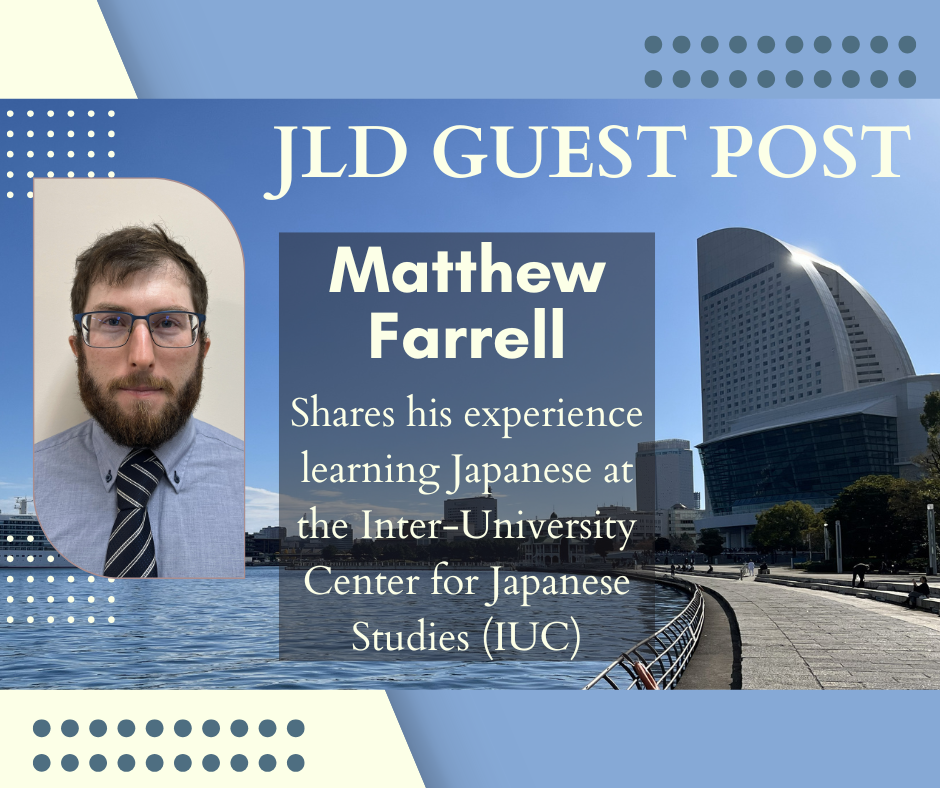
Hello All! I am a Japanese to English translator from Colorado with five years of experience working in the automotive industry in the Midwest. I spent the past year doing the 10-month program of the Inter-University Center for Japanese Language Studies in Yokohama (IUC)1 and am now applying to graduate schools for programs in translation. My personal interests intersecting with translation include reading in both my languages, gaming of both the card and video varieties, and the historical Japan-America relationship.
I first discovered the IUC by chance, listed as the publisher of a textbook for studying kanji. I re-encountered it many times while exploring ways to study Japanese in between schooling and jobs. It was not until much later and blessed with a growing awareness of my skill and knowledge gaps, that I finally re-considered IUC as a legitimate path to growth. In the midst of looking for ways to break the inertia that I was starting to feel in my career, the discovery that a colleague had attended the school was pivotal. After all, it was easy to question why I would need to spend more time studying Japanese when I was already successfully employed as a language professional. The genuine respect I had for my colleague’s translation and interpretation skills made it much easier to believe that spending a year on my Japanese skills would be worth it.
Underlying my whole thought-process was an ambition to dispel the intermittent feelings of imposter syndrome that plagued me especially when interpreting in high-pressure situations such as for the president of the company. I thought that my discomfort was tied to my inability to couch those ideas in the appropriate register, i.e. keigo, for those involved in the conversation. My colleague’s comfort with formal language and IUC’s focus on such made it a no-brainer. I also felt confident that IUC’s methods of teaching would match my learning-style based on previous exposure to their textbooks. The clincher came upon learning that I would receive funding covering much of the cost of the program through the generous support of the Toshizo Watanabe Foundation and the Fred and Ann Notehelfer Scholarship.
IUC provided a rough outline of its schedule and classes. The 10-month program is divided into four quarters ranging from strict focus on grammar and practical application in the first quarter to relative freedom to explore your own interests in the final one. This structure is one of the strengths of the program. It allows it to be accommodating to a wide range of student abilities. Students are grouped based on what they need to improve in the more cut-and-dry grammar classes and then later given more freedom to branch out their studies after building a common foundation. This takes the form of elective classes on subjects such as Literature, Law, and Business Japanese that introduce the mindset and jargon relevant for specific fields. It also fits within the broader vision of IUC as a gateway for young scholars preparing to act as professionals in the Japanese academic community. For someone coming from outside the ivory tower of academia, this focus on academic contexts at times felt ostracizing, but in retrospect, I believe that it is a crucial part of why the program can support the type of intensive study that it does.
I had a plethora of other expectations entering the program, some of which were upheld and others which were dashed. I expected a chance to improve my formal Japanese and that was one of my chief goals in attending IUC. The first quarter practically provided a bible on formal Japanese in the form of the excellent Taigū hyōgen course and the accompanying textbook “Learn through 20 situations: Keigo for Tailored Japanese Communication” (20の場面で学ぶ敬語コミュニケーションー気持ちが伝わる中級からの日本語待遇表現). There were ample opportunities to practice in the classroom, through periodic presentations, and on academic fieldtrips. These experiences did not completely expunge my feelings of discomfort in formal Japanese settings, but I do feel the program equipped me with the tools to continue improving on my own.
I also expected the workload to be immensely challenging. It was, but in surprising ways. There was very little jumping through hoops. There were no grades, other than scores given on some tests to help us contextualize our improvement. All assignments with hard deadlines fit well within expectations. But it was all the additional opportunities to learn that were truly time-consuming. Whether preparing for daily speeches, planning for class discussions, working my way through optional shadowing practices, or visiting places like the National Museum of Japanese History (国立歴史民俗博物館), there was more that I could do than I had time for. As someone who has always done “all the work,” I struggled at times to set clear boundaries on when I needed to stop.
The biggest surprises often came in revelations about my own Japanese skills. Going into the program, I thought that my major weakness was my ineptitude with formal language, but I found that it was actually my pronunciation and accent that were greater barriers to successful communication. I had mostly ignored pitch-accent in self-study up to this point, believing that it was unnecessary, but I found I was constantly being corrected because of my lack of awareness. In circumstances where I was speaking informally, language errors like these could be easily brushed aside in the give and take of conversation. But in more formal settings they were as much an issue as my skill at wielding keigo. Additionally, my written Japanese was burdened by the needlessly complex logic of my English thought, which did not transfer well into Japanese. Often, I could restate something in a way that would make sense, but my initial constructions at times missed the mark. Prioritizing clarity over complexity is something that I need to do in both my languages.
Amidst this discovery of my own flaws in Japanese, I really appreciated that many of the teachers at IUC were so direct and precise with their critique. There were moments where it was simply brutal, especially when I was shown exactly in what ways my command of Japanese was tenuous at best and deeply flawed at worst. In particular, I remember struggling over a clear pronunciation of the word shakai (society) in a speech. The teacher would not allow me to proceed until I fixed it. And there was the moment I came to tears over a discussion of a particularly convoluted essay with another teacher. But the very teachers who pushed me to the brink were there to comfort me afterwards. Their critique, while sometimes intense, was often key to deeper insights about my relationship with Japanese. While I do not subscribe to the belief that good teaching must be strict teaching, I feel certain that in the majority of my Japanese interactions prior to this, that the people communicating with me often took great pains to ignore or puzzle out my errors. Ultimately, this kindness was a disservice to my long-term growth in the language and it was good to be in a place where kindness took the form of pointing out my errors.
My favorite experiences came in the second half of the program. My literature classes in the third and fourth quarters (with the same teacher who was adamant about improving my pronunciation) were fantastic gateways into a wider world of reading Japanese. I had no idea just how accessible the world of literature could be. For context, the classes made reading Haruki Murakami in the original Japanese feel like a piece of cake. I also loved the (optional) course on historic Japanese grammar which introduced me to texts from the Heian period to pre-WWII Japan. While some of the other students on the program already had exposure to more specialized subjects like kanbun and kuzushiji, for someone who mostly learned Japanese by living in Japan, these were precious opportunities. Working one-on-one with a teacher on a project of my own choice in the last quarter was the highlight of the program. I deciphered and translated WWII documents preserved by the USS Cod Submarine Memorial in Cleveland, Ohio. Presenting on the challenges of that translation in the culminating graduation presentation is my proudest academic and professional achievement.
The only point of caution I have is that the IUC is not for the casual learner. To be comfortable and successful in the program, you need more than a strong desire to improve your Japanese skills. As I mentioned before, IUC is primarily oriented towards those pursuing academic careers in fields related to Japan. The majority of the student body and teachers will approach things from that perspective. As such, having an intellectual curiosity about Japan is vital. Though there were many like me from outside of the academic pipeline, they all shared that intellectual curiosity. If that does not describe you, I would take great care in considering whether IUC is right for you.
Having given that warning, if you are committed to any career that involves Japan, know that having top-notch Japanese skills will be vital to your success, and have the time to spend an intensive year2 studying in one of the coolest cities in Japan, there is no better adventure you could take than spending that time at IUC-Yokohama. Particularly for those non-native speakers of Japanese who want to succeed as translators or interpreters, I cannot think of a more perfect way to become intimately acquainted with your own knowledge of Japanese. Because the content of what we translate and interpret comes from sources outside of us, the broad scope of subjects introduced also provides fertile ground to branch out in new directions. Besides, you will encounter the most fascinating minds, both teacher and student, people who can be incredible allies in your professional journey.
Find out more about IUC 10-month Program here:
https://iuc.fsi.stanford.edu/programs-10M
Deadline for Fall 2026: January 21, 2026 11:59 PM EST
If youhave questions or would like to talk to someone about IUC, feel free to reach out to me at matthew.chauncey.farrell@gmail.com.
- Technically IUC-Japan, because there are IUCs for other languages such as the Inter-University Center for Korean Language Studies at Sungkyunkwan, which are not connected as far as I am aware. ↩︎
- For those with less time, check out the summer program! See the description here: https://iuc.fsi.stanford.edu/programs-summer ↩︎

Leave a Reply