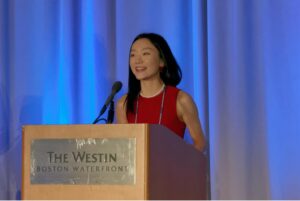
Photo: Luyi receiving the ATA Rising Star Award at the 66th Annual Conference in Boston.
At the 66th ATA Annual Conference in Boston, CLD’s very own Luyi Yang received the ATA Rising Star Award, which recognizes an early-career language professional for having already made an impact in the ATA community and the language professions in general. Right before the holiday season, Yifeng’s editor-in-chief, Sijin Xian, interviewed Luyi on Zoom. In the conversation, Luyi shared her volunteering journey, drive for excellence, and strategies for balancing her professional work and volunteer activities.
Q: Luyi, congratulations on the award! What was your first reaction when you heard the news?
Luyi: Thank you. I got the news in the e-mail, read it, and closed the e-mail because I was like, “What? Me? I can’t deal with this now.” I thought about it and replied the next day to say thank you.
Q: Why the shock?
Luyi: I just couldn’t believe it was me out of a million talented and hardworking colleagues.
Q: You’re more than deserving. This award celebrates professionals who are not only exceptional at what they do but also serving and making an impact in our community. That is clearly you, with your double ATA certification, court accreditation, and the many volunteer activities you’ve done. Could you give us a snapshot of your various volunteer roles?
Luyi: Thank you. I think this award is just another starting point for me to raise the bar and pay it back more to the community going forward. As for what I do, it’s a lot of small things that hopefully when added together, become something bigger than the sum of all its parts. I’m an admin for the Toronto Interpreters Practice. It’s been running for almost 9 years now with 260 members and about 70 to 80 practice sessions. We started in person at the Glendon lab at York University and then moved online, so now we have participants from all over the world. We also have a YouTube channel, where we upload our recorded speeches from the sessions, and now we have about 300 speeches for future interpreters to practice with.
In addition, I’ve been running the CLD translation practice group for almost three years. We’ve had 99 practices so far, so the next one will be the 100th. We’ve helped, including myself, eight people pass the ATA certification exam so far. I’m also an editor for the Yifeng blog, for which we’re recording this interview. I’m on the CLD Leadership Council, helping with whatever I can.
I’ve also participated in some court interpreting practice groups here and there. I help Glendon’s Year-2 students practice. And if somebody I knew was taking the local court interpreting exam, I helped them one-on-one to prepare.
Q: What an impressive list of activities! Being a member of both TIP and CLD translation practice groups, I can attest to the consistency of the work that you’re putting in, which is truly admirable. What keeps you going?
Luyi: I always believe that as a freelancer, as an interpreter, I have to keep getting better so that I can evolve and become more complete both as a person and as a professional. I think it’s this belief that pushes me to do the work, which is often unglamorous.
I think collectively, if we all have this mindset of wanting to get better, this is good for the industry because if we provide better service to our clients, educate them, show them what we can do, this grows the pie.
Q: Thank you for your service, truly. I’m curious, have you ever experienced moments of overwhelm and stress, like this might be getting a little too much?
Luyi: I think the stress doesn’t come from the volunteering portion alone. It’s in combination with my paid work. When I get busy, I do feel stressed and overwhelmed, like I have so much on my plate. Let’s take this month for example. I’ve had interpreting work every weekday, and on top of that, I have at least two to three translation jobs on my hand at any point. I still have one that’s 24,000 words that I haven’t finished, and I’m going to work on that through the holidays.
But I think I have two strategies that help. First is divide and conquer. Whenever I have a task, I break it down into smaller parts, like translate X number of words today and put it on my agenda, so I only worry about what I preassign myself for the day. This gives me a roadmap to follow so I feel less stressed. The other strategy is to think on the macro level. I’ll tell myself that the stress is temporary. After the deadline, I’ll catch a breath, and that the volunteer activities I do will pay dividends in the future.
Q: I love that. I think this is a great pivot from talking about your volunteer activities to your professional life. I’m a firm believer in the saying that how you do one thing is how you do everything. I’ve had the pleasure of volunteering with you, working with you, and practicing with you, so I know that this sort of consistency and commitment is something that you truly infuse into everything that you do. Can you tell us about how you stay committed to working on your craft?
Luyi: I agree with the saying. I think first of all, you have to like what you do. It’s not just something that pays the bills. If it’s something you like, you would want to keep getting better. And I tend to approach things with the same mindset, whether it’s preparing for a conference or running a practice group, or working through another assignment. Because I care about the fundamentals, the quality, and showing up prepared even when no one is watching.
Whether it’s interpreting, translating, or volunteering, a lot of it is really unglamorous behind the scenes, like scheduling small things, herding cats sometimes, doing the same kind of work over and over again, and practicing what didn’t go well and adjusting. Ultimately, it’s just consistent effort over time.
I also think commitment doesn’t mean doing everything perfectly. You have to be honest about where you are and stay curious. The goal is to keep getting better, and failing and iteration is just part of the process.
Q: Yes, very much so. And do you have a daily habit or routine that you swear by?
I think it goes back to my agenda, like setting goals. I have daily goals of what work I want to complete as well as monthly goals, such as spending five hours on practice or finishing a book. Sometimes I don’t, but at least I try. And I think you also must have the intention to carve out some space in your mind to practice consistently, like a thread that hangs over you.
Q: Yes, it’s really the micro habits that pay dividends in the long run. As we wrap up, any final advice you’d like to offer?
I would say don’t feel like you have to wait until you’re ready because sometimes you are not ever truly ready. Even with the CLD translation practice group, it was intimidating to post in a group chat of hundreds of strangers asking who wants to practice. I was so scared. I had to put it in my agenda so that it became something I had to cross off. I forced myself to take the first step, made the group, and then it just evolved from there.
And on that note, it’s really important to stay connected to people in the community. When I started, it was people who came before me who dragged me into initiatives, raised me up, and led me to where I am now. And I’m willing to give back. So you have to stay connected to the community to feel like you’re part of it in order to want to grow it.
Q: Thank you, Luyi, for your insights and for all that you’ve done for our professional home. Congratulations again!
Luyi: Thank you so much.

Luyi Yang is an ATA-certified Chinese<>English translator, conference interpreter, and accredited legal interpreter. She holds a Master of Conference Interpreting degree from York University. Luyi has been a member of the American Translators Association since 2023.
A former competitive archer, Luyi brings the same focus and composure to her work in fast-paced, high-stakes settings. She has been entrusted to interpret in courtrooms, corporate boardrooms, and government offices alike, supporting decision-makers in multinational companies, public agencies, and other critical sectors. Known for her ability to navigate complex and technical materials, she delivers clear, natural, and nuanced renditions even under intense pressure.
Beyond her client work, Luyi leads multiple practice groups and helps foster spaces where translators and interpreters can sharpen their skills and learn from one another. She has learned from brilliant mentors throughout her career and is equally dedicated to paying it forward. A firm believer in continuous education, lifelong learning, and collective advancement, Luyi is committed to strengthening individual T&I professionals so that the entire field can thrive.

Leave a Reply