By Yueyi Dai
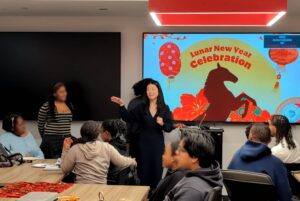
Photo: Yueyi hosting the Lunar New Year Celebration at Howard University
My first encounter with interpreting was in the summer of 2015. Although I was an accounting student at the time, I have always had a passion for languages. At the recommendation of a friend, I enrolled in an interpreting course at Transmax, a professional interpretation academy, hoping to strengthen my English skills. Little did I know that this would mark a turning point in my life, ultimately shaping both my career and, years later, my teaching philosophy.
I began with an intensive two-month course in Consecutive Interpreting. Through immersive exercises and realistic professional scenarios, I significantly strengthened my English and discovered a profession I had never known existed. I became hooked by the challenge of interpreting and fell in love with helping people communicate across linguistic and cultural boundaries. After the course ended, I began taking more interpreting courses and later enrolled in the Conference Interpreting program at the Middlebury Institute of International Studies (MIIS), a testament to how much my command and understanding of the English language and culture had deepened.
A decade later, I found myself on the other side of the classroom—as a Chinese language instructor at Howard University in Washington, DC. Last year, I was asked to develop a curriculum for a new course called “Oral Expression I,” designed to strengthen students’ spoken Chinese and overall communicative competence.
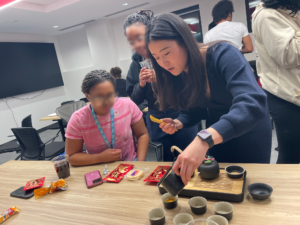
Photo: Yueyi demonstrating the Chinese tea ceremony and tea culture at a Howard Chinese Culture Club event.
While designing my lesson plan for the course, I reflected on my own English learning journey and the interpreting training that had changed my life. I began to wonder if the interpreting techniques I learned at Transmax and MIIS could benefit language learners who are not training to become interpreters, such as my students. Interpreting requires proficiency in both the source and target languages, as well as the ability to move fluidly between them in real time. This demand had pushed me to refine my second language, English, as well as my native Chinese. It also led me to believe that a similar approach could support students learning Chinese as a second language.
With that in mind, I began exploring interpreting-based tasks in language learning and how they might be applied in the classroom. After some research, I found that there is an ongoing debate around interpreting-based pedagogy. While some scholars raise concerns about the cognitive demands of interpreting activities and the challenges of assessment, others support the approach with strong empirical and theoretical evidence. Therefore, I decided to try this method in my own teaching, while addressing its potential challenges. For example, I structured the activity into three stages to reduce students’ cognitive load and put more emphasis on meaning rather than rendering word-for-word.
I began designing a series of interpreting activities based on the topics that we would cover in the coming semester, using them as review sessions after finishing each lesson/topic. For example, one of the upcoming topics is “transportation.” I created a liaison-interpreting scenario, where students need to help a Chinese visitor in DC communicate with a transit officer and navigate the city after her cellphone has died. To simulate a real-life interpreting situation, I only gave them the keyword “transportation” in the beginning, requiring the students to conduct their own background research and build a glossary. On the day of the activity, my TA and I played the roles of the transit officer and the Chinese visitor respectively, while my students came up to the stage one by one to interpret for us.
Surprisingly, the activity was well received. The students were all very excited—and understandably, a little nervous—throughout the exercise, and described the experience as “engaging,” “fun,” and “helpful.” I also found the experience deeply rewarding. It was meaningful to see students benefit from the same method that had once played a key role in my own language learning, even though they were engaging with a different language.
The reflection that students wrote after the activity revealed that their language skills, especially speaking and listening skills, were strengthened through this exercise. One student wrote, “I believe this activity is helping me improve both my comprehension and speaking abilities. I need to fully understand what’s being said in both languages to clearly translate the meaning to both people.” Meanwhile, another student said, “I also feel I improved my vocabulary use. While I was studying the glossary, I definitely learned a lot more words that I can use in the future…Overall, the activity improved practically everything. I think activities like these are absolutely beneficial for language learning.”
Other students noted development in their communicative competency. One stated: “I noticed that some [Chinese] responses reflected more indirect communication styles compared with English. To make the communication clearer, I focused on conveying the intended meaning rather than translating word-for-word, ensuring that the message sounded natural in English.”
Furthermore, the mediation between two languages encourages students to notice, compare, and reflect on the differences and similarities between the two. As one participant with experience living in a Chinese-speaking region noted, “People are more humble and apologetic in Chinese and say 不好意思 (excuse me/pardon) and 对不起 (sorry) a lot. However, it is unnecessary to interpret it as an apology all the time.”
The positive feedback from students instilled confidence in me to adopt this pedagogy on a larger scale, write a practice-oriented paper to conduct deeper studies on this technique, and share my findings with other language educators. Drawing on Bialystok and Ryan’s proficiency model and the Intercultural Language Teaching (ILT) method, I explored how interpreting-inspired pedagogy can be integrated into language teaching. In my paper, I detailed classroom practices that incorporate liaison interpreting activities as structured communicative tasks and how to adopt them in class.
This paper will be published in a collaborative issue of Transformative Dialogues and Mind and Method in September. In addition, I am also collaborating with a peer from MIIS, who is also a Chinese instructor, to experiment with this pedagogy together in our own classrooms. This November, we will present our findings at the 2026 American Council on the Teaching of Foreign Languages (ACTFL) Annual Conference and gain insight from other language educators. This new experiment has truly been a full-circle moment as we educate the next generation of communicators that bridge languages and cultures.
 Yueyi Dai is the Chinese Lecturer in the Department of World Languages and Cultures at Howard University. She completed her MA in Conference Interpretation at Middlebury Institute of International Studies at Monterey. Apart from being a Chinese language educator, she is also a professional conference interpreter and has provided translation and interpreting services to academic institutions, think tanks, and tech companies, as well as financial and international businesses. Among the clients she has worked for are Boston University Global Development Policy Center, NYU Shanghai, Stanford Graduate School of Business, Cisco, SelectUSA Investment Summit, TEDxPuxi, Shanghai Conservatory of Music, and Mahua FunAge Theatre Group.
Edited by Ben Murphy and Sijin Xian.

Leave a Reply