

By Safira Amazan

Introduction
The latest ATA-LTD TEKTalks webinar featured Steven Bammel, who presented an overview of CotranslatorAI, an AI-assisted Windows application developed with the needs of professional translators in mind.
About the Speaker
Steven Bammel is a Korean to English translator with more than 20 years of experience in the language industry. An active member of the ATA, he brings a unique combination of linguistic expertise and a background in strategic management and economics, a perspective that has shaped his interest in efficient, secure, and human-centered translation workflows.
The Focus of the Session
From the outset, Bammel emphasized that CotranslatorAI is not an automatic translation engine and not intended to replace machine translation (MT). Instead, he described it as a human-led workflow assistant—a tool that foregrounds the translator’s expertise and gives professionals more control over style, consistency, and decision-making in an increasingly AI-driven work environment.
Across the webinar, he underscored a challenge familiar to many practitioners: while general-purpose AI models and MT systems offer remarkable speed, they often fall short in areas where translators require precision and reliability. It is in this gap—between automation and professional standards—that CotranslatorAI positions itself. The tool is designed to support translators’ workflows without taking over their work, reinforcing the human role rather than diminishing it.
Who Is CotranslatorAI For?
According to Bammel, CotranslatorAI’s core audience is simple: Freelance translators. “That’s basically who we’re designing it for… that’s what I am, and that’s what our team is.”
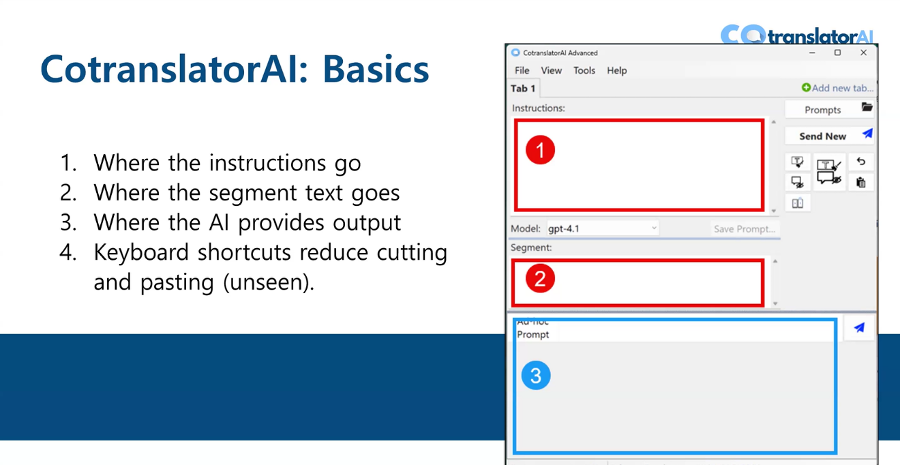
So, CotranslatorAI was developed primarily for freelance translators, reflecting the experience of its creator and development team. True to that focus, the tool operates locally as a Windows desktop application (Mac users may use Parallels or similar), keeping all project data on the user’s own machine.
No content is stored by CotranslatorAI itself. Instead, when the software interacts with AI models, it does so through the OpenAI Enterprise API, which provides:
- No training on user data
- No retention of prompts or outputs
- Encrypted transmission
This approach reflects increasing interest in secure AI workflows, especially among translators working with sensitive or confidential material.
Why CotranslatorAI?
A Human-Led Alternative to MT and Generic AI
The motivation behind designing CotranslatorAI came from recognizing the limitations of general AI tools and vendor-built CAT integrations for the work that we do as translators.
One of the most important segments of the webinar was the comparison between traditional machine translation (MT), generic AI chat tools, and CotranslatorAI.
1. MT/AI – Faster, but with Predictable Limitations
Bammel summarized what translators experience daily:
- MT often produces unreliable output.
- It frequently repeats the same errors throughout a text, forcing translators to fix identical issues repeatedly.
- MT cannot maintain your style, preferences, or project-specific decisions.
- MT is fast, but it often drags translators down with corrections that feel more like janitorial cleanup than translation.
As Bammel puts it:
“We spend our days fixing the same mistakes… the machines help, but they give us output that’s not reliable.”
2. CotranslatorAI – Human-Led AI = Consistency, Style, Context, and Flexibility
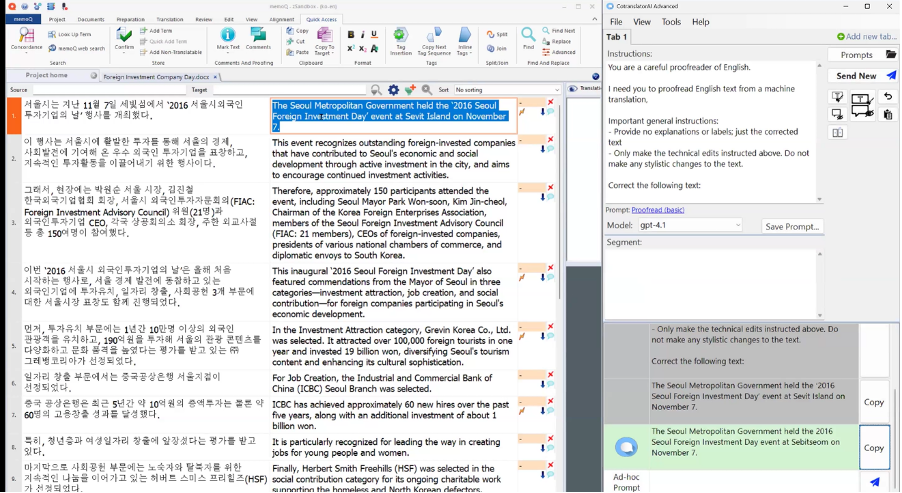
CotranslatorAI offers a contrasting model: the translator leads, and the AI assists. Instead of accepting the output first and correcting it afterward, translators create and refine prompts that guide the AI toward desired terminology, structure, and style. That means:
- The human always goes first.
- The translator gives the instructions; the AI follows their rules.
- Prompts evolve iteratively as the translator adds terminology, stylistic rules, or exceptions.
- The output improves segment by segment, reflecting translator’s voice and decisions.
“We have our consistency, our style, our ability to write better than the AI, said Bammel, our context-sensitive decisions that we make on the fly… and we need to bring those into our workflow.”
This approach allows translators to integrate their own:
- Writing style
- Terminology decisions
- Consistency rules
- Context-based judgment
In this sense, CotranslatorAI is less a translation engine and more a customizable assistant that can help reinforce the human translator’s preferences and expertise. Rather than reacting to unpredictable MT output, translators proactively train the system to produce what they want.
3. Why This Matters
Generic AI systems tend to hallucinate, oversimplify, or apply rules inconsistently. Tools that support translator-first workflows, rather than automated output, help mitigate these issues by allowing professionals to maintain control over:
- Instructions
- Revision decisions
- Terminology and stylistic requirements
CotranslatorAI mitigates this by giving translators:
- Full control over instructions
- A private prompt library
- The ability to iterate prompts live during translation
- A structured workspace to run terminology checks, QA checks, style guidance, and more without leaving the translation task.
Everything is traceable, customizable, and purpose-built for professional workflows. This shift highlights a broader industry conversation about how AI can best support translation work without diminishing professional autonomy.
GAIT: Generative AI Iterative Translation
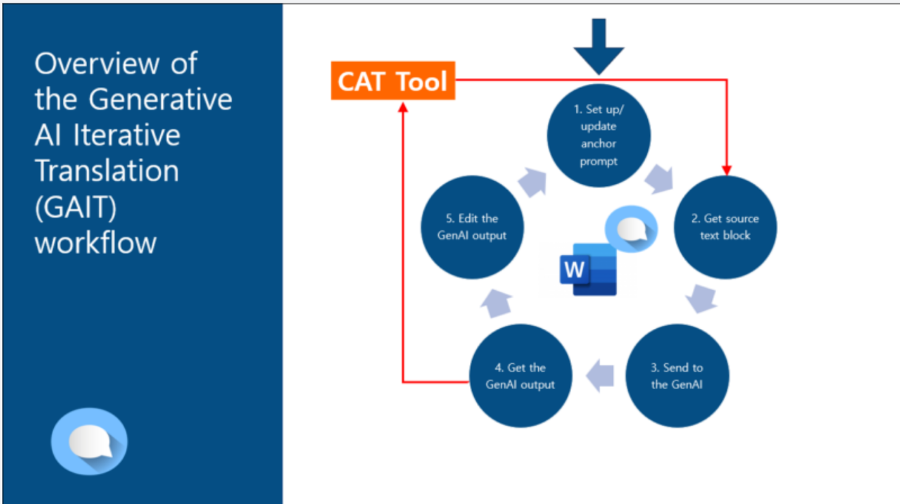
One of CotranslatorAI’s flagship features is the GAIT workflow (Generative AI Iterative Translation). GAIT allows translators to:
- Export bilingual files from CAT tools
- Process pages at a time, not just segments
- Provide large context windows to the AI
- Apply iterative prompting across blocks of text
- Improve quality through repeated refinement cycles
More context equals better quality, more consistency, and fewer contradictions. This workflow differs from traditional MT because the translator builds and modifies the instructions as the translation evolves, improving consistency and reducing error propagation.
GAIT is especially powerful for long documents or narrative-driven translations where cohesion matters.
Built for Real Translation Workflows
While CotranslatorAI can support translation from scratch, the TEKTalk focused mainly on workflow integration, demonstrating how the tool can support several steps of the translation process.
1. Iterative Prompting
Prompts can be adjusted mid-project to incorporate:
- Terminology choices
- Formatting preferences
- Style requirements
- Naming conventions
- Date and number formatting
Because prompts evolve with the translator’s decisions, consistency increases across segments.
2. Multi-Tab Workspace
The interface allows users to create dedicated tabs for tasks such as:
- Revision
- Terminology checks
- Style-guide queries
- Quality checks
- Re-translation assessments
This design acknowledges the multifaceted nature of translation work, where translators often juggle multiple reference sources and tasks simultaneously.
3. Segment-Level or Bulk Processing
Although the demonstration addressed one segment at a time, CotranslatorAI also supports:
- Multiple segments processed together
- Pages of text via bilingual Word exports
- Context-preserving refinements
This flexibility means it can integrate into workflows involving MemoQ, Trados, Trados Cloud, Phrase, Smartcat, and other CAT tools.
4. Works in Any Language
The tool itself is language-agnostic. AI models do not silo languages; quality is determined by available training data and clear translator instructions. As long as the translator’s prompt contains the language instructions, and the OpenAI model supports it, CotranslatorAI can operate in any linguistic environment.
AI Translation and MT vs. CotranslatorAI: A Quick Summary
| Machine Translation (DeepL, proprietary MT, etc.) | CotranslatorAI |
| Fast and automatic | Human-led, prompt-driven |
| Repeats mistakes | Learns your evolving rules |
| Output inconsistent across segments | Highly consistent (iterative prompts) |
| Ignores your personal style | Maintains your style and voice |
| Limited context | Can ingest large blocks (GAIT) |
| Fabricates details | Steered tightly by your expertise |
| MT goes first, translator reacts | Translator goes first, AI assists |
Data Security & Compliance
CotranslatorAI relies entirely on OpenAI Enterprise API, which means:
- No training on your data
- No retention of your data
- Encrypted transmission
- Enterprise-grade privacy
Bammel noted that EU-specific hosting (e.g., Azure EU) is not currently built in, but for most professional needs, the API’s security meets or exceeds typical MT-provider standards.
Learning Curve and Cost
CotranslatorAI is intentionally affordable with a 15-day trial with built-in training. Many translators can see benefits within their first project, even without exploring the advanced functionality.
Final Thoughts
CotranslatorAI illustrates one approach to integrating AI into translation workflows in a way that keeps the human professional at the center of the process. Rather than positioning AI as a replacement for translators, the tool demonstrates how human-led prompting, iterative refinement, and context-aware decision-making can shape AI output to better align with professional standards.
Bammel’s presentation highlights broader industry considerations: as AI becomes more embedded in language work, translators may benefit from exploring workflows (i.e. GAIT or iterative prompting) that allow them to maintain oversight, apply their judgment, and preserve stylistic and cultural nuance. These practices underscore the continuing importance of human expertise in multilingual communication.
For more details, please visit: https://cotranslatorai.com
Q&A from the audience
Q. Can you tell us what kind of language tool CotranslatorAI is?
A. CotranslatorAI is an AI-powered standalone application designed specifically for language professionals. It is not a CAT tool nor does it directly plug in to a CAT tool; instead, it works alongside your existing programs to enhance your workflow both inside and outside your CAT environment.
Q. What computer environment does the typical user need to use CotranslatorAI? (OS, OpenAI account…)
A. To use CotranslatorAI, you need a Windows computer (or Parallels on Mac) and an OpenAI account at platform.openai.com (not ChatGPT at chat.openai.com)
Q. What kinds of CAT tools are compatible with CotranslatorAI?
A. Any program that allows text entry is compatible. This includes any CAT tool, Microsoft Office products, Internet browser, etc.
Q. How does the output of CotranslatorAI compare to the output of some more standard automated tools, like DeepL or ChatGPT?
A. In the demo, we saw the quality from DeepL. That represents the workflow in the typical industry narrative: the machine goes first; the translator cleans up the mess. This is “human-in-the-loop automation”. CotranslatorAI flips this logic on its head, with “machine-in-the-loop” workflows. With CotranslatorAI, the translator takes charge of the AI’s output first, making the machine give back something so much better. In the MTPE demonstration, we saw how we can add our human expertise to the process and improve DeepL’s machine translation through an accelerated, iterative post-editing process.
Translators can also craft translations from scratch, but in our own voice. CotranslatorAI uses the same AI models as ChatGPT, but faster and with more transparency and data security.
Q. How do you think CotranslatorAI will give linguists and small LSPs an edge on the current market?
A. CotranslatorAI gives you an edge by letting you work faster and smarter with advanced AI prompts that you can tailor to your needs. Unlike standard CAT tool features, you can boost your productivity, quality, and creativity while staying in control and keeping your data private. As you build up your own prompt library and get more skilled with the tool, you’ll be able to deliver better results and stay ahead of the competition in a way that’s hard for others to copy.
Q. What can an average user expect in terms of costs when using CotranslatorAI? (Pricing model, subscription vs. license for life, cost of support, any add-on services, etc.)
A. You can start with a free trial. After that, we have two paid editions at $47 and $87/year. You will also need to pay for the tokens you use through the AI models, and this generally costs around $5/month for most users.
Q. How long would a typical new user need to invest before being able to master CotranslatorAI? Do you offer training or coaching?
A. You can apply today’s workflow and start getting results immediately. But the tool has advanced functions, too. Basic training is available with your free trial and subscription; you can purchase advanced training and coaching as well.
Q. Can you describe the process of getting support for CotranslatorAI? Methods of contact? Putting in a ticket? Average/guaranteed response times? Customer service availability (24/7 or otherwise)?
A. Paid users can get free support through the website. There are two of us covering this now, and we don’t have guaranteed responses times and we aren’t awake 24/7. But we’re pretty fast!
Q. How is CotranslatorAI designed to maximize data protection?
A. CotranslatorAI maximizes data protection by operating as a small application installed directly on your Windows computer, rather than as a cloud-based service. This means your data is never accessed by us. All data is securely exchanged only with OpenAI’s AI models using industry-standard HTTPS encryption. Additionally, OpenAI does not use your data for model training, does not share it, and deletes it promptly according to their Enterprise Privacy Policy.
Q. What is your long-term mission with CotranslatorAI and what future developments have you planned?
A. Our goal is to give translators a tool that puts them in control. At the moment, we are putting the final touches on our next major update, which will add easier onboarding options; additional workflow accelerators; an improved main window interface; a new workspaces feature; and more robust support for AI settings, including support for the latest reasoning models; and more. Ultimately, we want to develop CotranslatorAI into a tool that supports freelance translators in their core professional workflows.
Q. Please elaborate on the security of this tool. As a freelance translator located in Europe, I am bound by the strict EU rules of privacy and confidentiality, especially for IP themes, such as yet undisclosed patent descriptions and claims. Adding to this, I am bound to use only MT tool with servers and storage within the EU. Any AI tool hosted outside the EU is considered to be non-compliant with the GDPR.
A. Please refer to the OpenAI privacy policy for API access, which CotranslatorAI uses: https://openai.com/enterprise-privacy/. This is the level of data security you can expect.
Q. Is it possible to run several segments at once? Or does it only work segment by segment?
A. Yes, you can run multiple segments through at once. There are various techniques for doing that, demonstrated in the documentation and paid training.
Q. Can you save these prompts to reuse them later on? I am thinking of certain clients or text types where you need the same result recurrently over time.
A. Yes, absolutely. That’s what the CotranslatorAI Prompt Library is for! You can save dozens and hundreds of pre-purposed prompts for each and every use case you need.
Q. What languages are supported?
A. CotranslatorAI is not limited by language. You can write your prompts in any language and ask the AI for responses in any language.
Q. What are some “must-haves” for an effective CotranslatorAI prompt? Are there any particular phrases, structures, or prompt lengths that work best? Do certain types of wording or sentence styles help the AI produce a clearer and more accurate response?
Has this model been evaluated for handling culturally specific inputs during translation (like in a novel or marketing)? Specifically, can I instruct it to search or prioritize a particular corpus of culturally relevant materials (let’s say on the internet or in uploaded materials), and how reliable are its responses? I’m aware language models sometimes produce fabricated details; how does this tool manage or mitigate that issue?
A. Free prompting training is available with the 15-Day CotranslatorAI Easy Launch Trial at https://CotranslatorAI.com/Easy
Q. How would you recommend marketing work with CoTranslatorAI to potential clients (whether agencies or direct clients)? How would you recommend setting rates for work with CoTranslatorAI with respect to our going rates for pure translation vs proofreading and/or MTPE, etc.?
A. Rates are falling, of course. But if you can bump up your speed by 50% with CotranslatorAI, offer your clients a 25% discount. It’s win-win, and helps to open the market for more work. I personally offer 50% discount on MTPE, compared to full translation. But the workflow is often the same; I just work twice as fast when doing MTPE.
Q. Do I need to open an OpenAI expensive enterprise account?
A. It’s just called an “enterprise account”; it’s not expensive. Most users are spending about $5/month.
Q. Do you need one shortcut to copy to CotranslatorAI and another to paste back into MemoQ or does it happen in 1 shortcut?
A. The Paste Response shortcut does the full round trip with one shortcut.