

Susan Pickford recently ran a workshop called “Translate Like It’s 1825.” Kate Deimling spoke to her about translator productivity, delivering translations via pigeons, and what has and hasn’t changed about the translation market in the past 200 years. This interview took place on Zoom and has been edited for length and clarity.
Kate Deimling: You ran a workshop with students in Mulhouse, France called “Translate like it’s 1825.” What did the workshop involve and how did it come about?
Susan Pickford: I should have said 1826, which would have been better for the timing—200 years—but I kind of screwed that up! Retrospectively, now I would say 1826. I’ve been translating for a long time, I’ve been researching for a long time, and I really wanted to bring the two together and kind of research translator careers. Not from the point of view of literary translation as a kind of creative endeavor—that’s very valid, obviously, but there’s been a lot of work on that already. And I wanted to look at it more as a business practice, which I think is an underrated and undervalued component of what we do.
So I was toying around with this idea for a while, and I ended up writing this book about translators in history and what their working experience was. Back in 2010 I spent a week at an archive in France looking at translator contracts from the nineteenth century. And there was so much data that nobody had ever looked at, about who was getting paid, how much, for what languages, and so on. It was just fabulous. There was so much data that I wrote a book about it, which came out last year, Professional Translators in Nineteenth-Century France.
And it really got me thinking about how have expectations of productivity changed over time? Because I look at what people can do now with all the contemporary tools and access to the internet and so on.
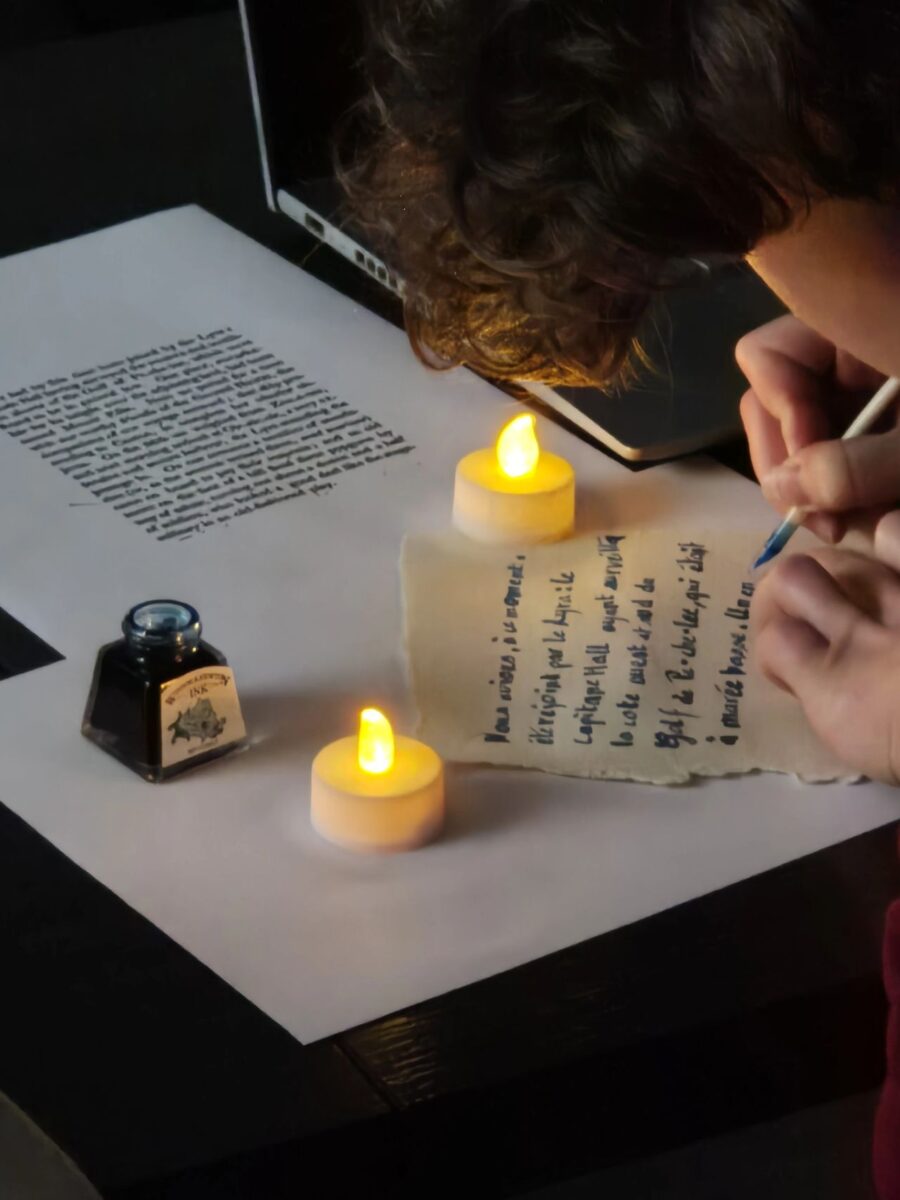
So I had this idea of doing a historical workshop, kind of like a reenactment. Kind of like experimental archeology where you build a castle using old-fashioned technology. There’s one not far from here, actually, Guédelon. So I thought: how can you apply that to translation? So if you’ve got an old dictionary and some candles for the lighting, and in terms of writing technology, you’d have a quill pen. And that really slows you down, because you’re having to dip it into the ink. So I kind of put all that together. The students were really receptive, I have to say, and it was a really good experience.
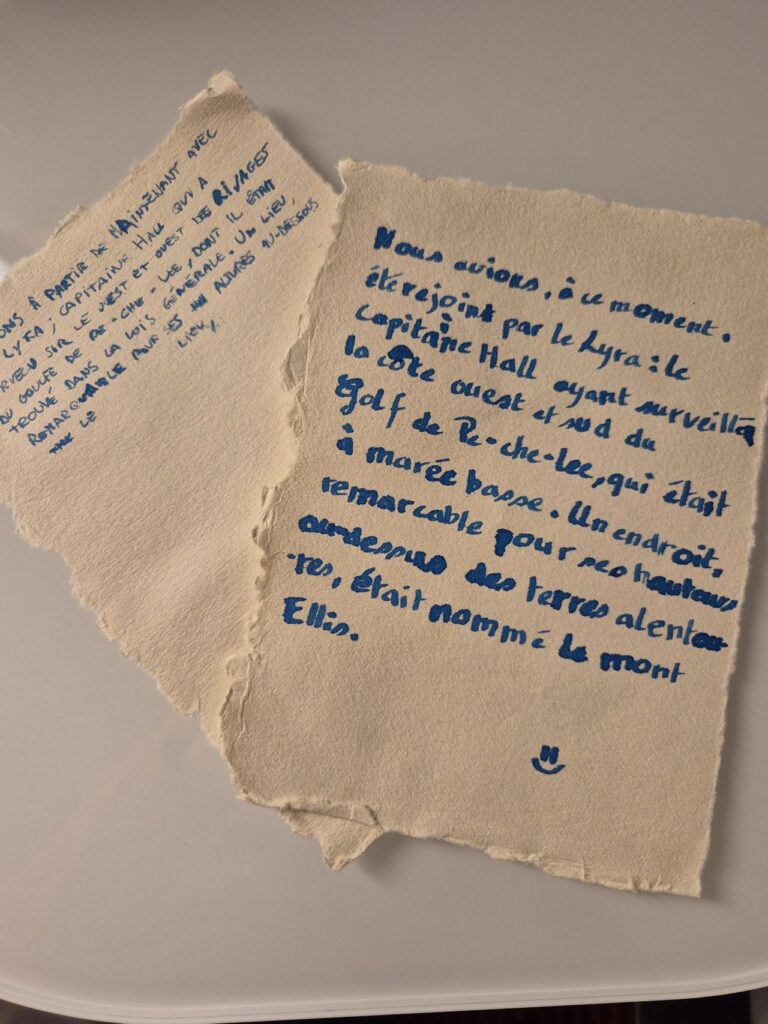
The big surprise for me is that actually they got more done than I thought. I guess because their brain…the hand speed matched their brain speed, I guess? So I guess the big question for me now is how much have brains speeded up over the last 200 years. And that’s a different question.
KD: What kinds of texts were the students translating? Were they all doing the same text, or different ones?
SP: They all did the same text. It was an extract of a travel narrative published about 1819. The reason I chose that is that in my book I did a deep dive into the career of this one guy who was a translator named Defauconprêt, who translated Walter Scott and The Last of the Mohicans and such. And I chose him because his name is on an awful lot of stuff—like 400 books. There were all sorts of rumors at the time that he ran a translation factory. And in fact he was quite open about it, that he ran a kind of workshop where people would get ten pages a day [to translate] and then he would just put them together. He was a real kind of translation entrepreneur.
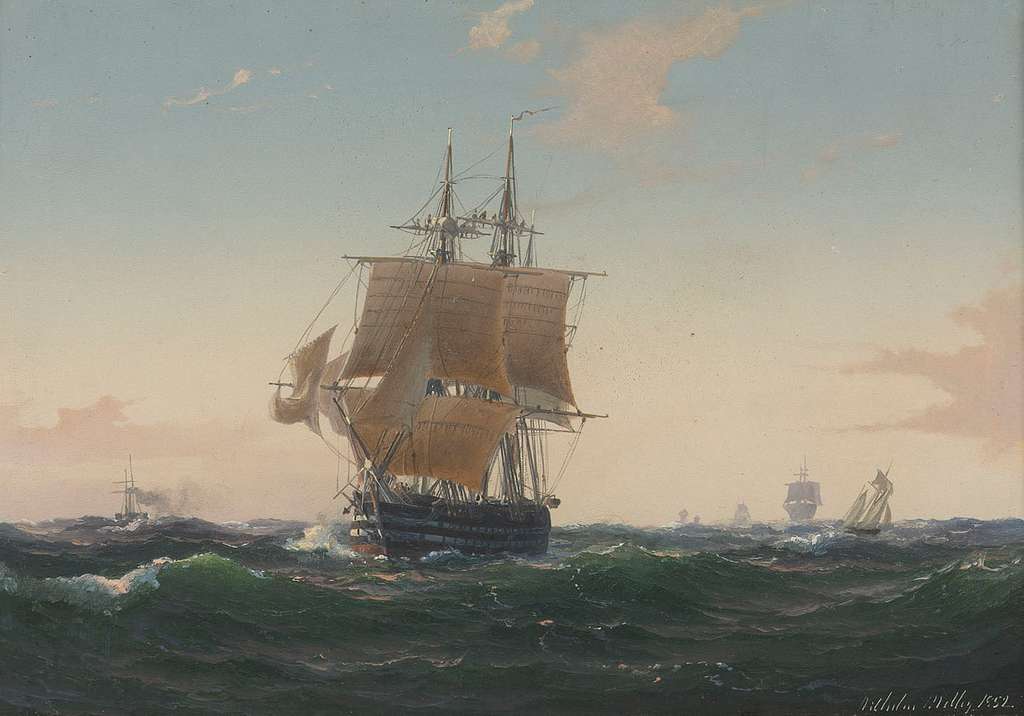
Travel writing was a big genre at the time. These books were really, really popular, and it was pre-international copyright, so you basically had to be the first person to market. And they weren’t waiting for the book to be finished, so it was really kind of just-in-time project management. You would have people going to the printers and taking the pages as they came off the printing machines, and basically working from wet print.
KD: Wouldn’t the original books be published someplace else? Wouldn’t it be hard to get the pages fresh from the printer?
SP: Defauconprêt at this point was based in London, so he would go to the printer, get the pages off the machine, kind of slice and dice among his team, and then the French translation would be sent to Paris to be published in Paris.
KD: Okay.
SP: And I don’t think Defauconprêt did this, but they did have carrier pigeons and could get texts wrapped around the leg of a pigeon from London to Paris in eight hours.
KD: Wow. You’d have to send a lot of pigeons, I guess, right? Because you couldn’t put a whole novel on one pigeon.
SP: No, I don’t think it would work for books, but they used it for news translation definitely.
KD: So Defauconprêt’s name must have been a selling point for these translations. Thinking about the debates today about the translator’s name on the cover of books…was it unusual that he had his name on his work? Or was it pretty common?
SP: It was probably about the same as today, I would think. He had admirers, but he also had detractors as well. You know, some people were keen because they got the stuff fast, and other people were moaning that it was a bit slapdash and the quality wasn’t great. Which was probably true because basically, anything that was challenging, they would just skate right over it. I mean, given the tools they had, I think they did the best they could.
KD: Among the translators you studied in nineteenth-century France, were there gender differences and class differences that stood out to you? I know this is a big question, and there might not be time to summarize your whole book right now, but just briefly.
SP: What I can say certainly is that women are much harder to find evidence about. A lot has gone missing, or there are changes of names with marriage and so on that just make it much harder to trace. From the data I found in the publisher archives, women were doing the commoner languages and the more popular literature. So they were doing things like English children’s books, and obviously in the market that’s quite a crowded place to be in, so they were getting less recognition and less pay. And then the people who were getting paid the most were doing Latin and Greek for the school market, because that was an obvious readership, and it would be men doing that. So you can see a real gender gap there.
KD: In terms of translators trying to survive in the market and having these time pressures, would you say there’s a continuum from that period to today? Or do you see any big changes?
SP: I think it’s important to be aware of the historical rootedness of the economics of the translation market. Even back as far as the eighteenth century, there is a German book, Sebaldus Nothanker, which is a satire on publishing that has a whole bit about translation factories. The nature of which languages are more in demand or less in demand has shifted. But the basic underlying mechanisms of selling a service in a crowded market have not changed at all.
KD: I guess AI is kind of like the ultimate translation factory, a factory without human workers. For certain language pairs you could get a translation practically instantly, but it wouldn’t have the human touch or quality control.
SP: There’s kind of a longstanding discourse about this back to the eighteenth century, about translators as machines. The translation process as kind of like going through a mill, or like steam engines and so on. My feeling on AI is that I really dislike it, and I’m very open about that. I think that we need to be quite canny in our discourse in that, for some publishers, there is obviously the cost savings. And the time savings are going to be very, very tempting. I can see why translation would seem to be a bottleneck in the process. And I think we really need to talk a lot more to readers about it and see what readers think about it, because that’s not really something that’s been part of the discourse so far.
For example, I’ve been looking at Chinese web novels, which is not something I read myself, but there are people who are real fans of this kind of wuxia martial arts stuff. And when you look online, there are people who have completely gone over to AI translation, because it’s giving them what they want immediately. And there are also people who are saying, no, the quality’s not there, I’d rather wait. But there are really two schools of thought among the readers. I think that we need to think more about it from the point of view of all the people in the chain, framing our arguments not just in terms of translator interests, but also across the board.
KD: So to go back to the workshop, how did students respond to the experience? What are the benefits of translating like it’s 1825? Should people give it a try?
SP: I think people should try it. I should have copyrighted the idea, really, shouldn’t I? If people do want to talk about it more, I’m up for it, so hit me up if you want to hear more about it, basically. The students really reacted very positively. They were really engaged, and they were not necessarily literary specialists. It made a very cozy atmosphere as well, because we switched off the lights, and we had little LED candles, and it was just…it was kind of a nice bonding experience, and it was very sort of haptic.
KD: And they were already studying translation?
SP: Yes, they were in a master’s program, mostly in technical translation. And I think it got them thinking about the continuities between past and present in professional practice, and [gave them] an awareness that there was a body of people that had gone before them. I’m planning a version with my current students where I have a kind of multi-step thing where we have 1826, and I’m going to try and do 1956 with typewriters. And then hopefully one sort of in 2036, where it’s AI post-editing and see how they feel about that.

Susan Pickford is a professor and head of the English unit at the FTI, University of Geneva, where her research focuses on translator history and sociology and the cultural economics of translatorship. Her recent publications include Professional Translators in Nineteenth-Century France (Routledge, 2025). Her guide to literary translation as a workplace practice, Translating Books for Publication, is due out in Routledge’s Translation Practices Explained series in August 2026. She is also a longstanding translator, having published her first translation in 2001, and acts as a quality assessor for various national translation funding bodies. She has two literary translations due out this year, Sarah Jollien-Fardel’s Tether and Moussa Konaté’s Headless in Kita.
Kate Deimling is the administrator of ATA’s Literary Division and a professional translator of French fiction, non-fiction, and poetry. Her latest book translation is The Story of the Marquis de Cressy by eighteenth-century author Marie-Jeanne Riccoboni (MLA Press, 2025). Her poetry translations have appeared in Atlanta Review, World Poetry Review, and Best Literary Translations 2026. She holds a PhD in French from Columbia University and has spoken on the craft of translation at institutions including Binghamton University, the Middlebury Institute for International Studies at Monterey, and Duke University. Her debut poetry collection, Time Traveling, came out from Cornerstone Press in 2026.