


By Liza Tripp
Translation often involves working your way around layers of meaning, and translators employ a host of strategies to accomplish this in print. Yet what happens when the action moves to the stage, itself a form of translation? I recently spoke with Steve Smith to discuss his Portuguese to English translation of An Orchard For Chekhov [Um jardim para Tchekhov], a 2024 comedy written by Brazilian playwright Pedro Bricio. The play, staged by The Upstream Theater, an internationally-focused theater company, had a successful three-week run at the Marcelle Theater in St. Louis, and starred regionally renowned actors Sally Edmundson and J. Samuel Davis. Upstream’s founding director Philip Boehm is a translator in his own right, working from German and Polish, and the company frequently features international works he finds, acquires, and has translated. Smith and Boehm met through an online theater-in-translation group (should you need reminding of the many benefits of staying active in the translation community).

An Orchard for Chekhov tells the story of Alma, a once-famous Brazilian actress who has not worked for years. Down and out, she arrives in Rio to live with her daughter until she can get back on her feet financially. While there, she gets the idea to stage and star in Chekhov’s final work, the tragicomedy The Cherry Orchard. Soon after, she meets a man who calls himself Chekhov (or maybe he is Chekhov?), who encourages her to do it. The play explores themes of art, longing, and memory, and how those themes can reemerge across cultures and time periods. Given the thematic layering of the original, the translated work could have been confusing and disorienting—polyphonic in all the wrong ways.
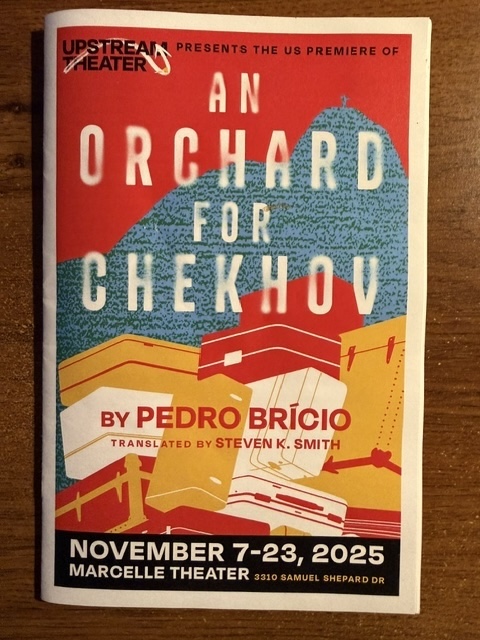
Instead, the translated production somehow melded all these themes and cultures into something cohesive, entertaining, and oddly enough—believable. As theater critic Bob Wilcox noted: “But as soon as the play begins, you are asked to believe that this is not some kind of habitat in St. Louis but an apartment in Rio de Janeiro, Brazil, and a patio beside a street. Sally Edmundson is piling up luggage near the street. But she is not Sally Edmundson, she is Alma Duran, a Brazilian actor, trying to hail a cab to take her and her luggage to her daughter’s apartment. When the cabbie finally stops, they converse, of course, in Portuguese, the language of Brazil. But we hear them in English, thanks to the translator Steven K. Smith. So our suspension must grow.” That the audience accepts the premise is no doubt thanks to the alchemy between Steve Smith’s attentive translation and Philip Boehm’s nuanced staging.
One technique Smith used was to not over-translate, especially the simple things. One example he mentioned was requeijão, the word for a spreadable cheese that shows up a lot in everyday Brazilian life. It is often translated into English as “cream cheese.” Yet for Americans, cream cheese brings a slew of its own connotations (many of the 1950s Americana sort, at least to my mind) and none of those really make us feel like we are in Brazil. To me, this example was a reminder of how successful translation can build a sense of place cumulatively over the course of a work. Another technique, which Smith credits mainly to Boehm, was to scatter some additional Portuguese words and phrases into the translation. These words were not huge conveyers of meaning, but rather verbal markers of the source text and culture, a kind of mood-maker to help the audience understand and accept that these English speakers were actually Brazilian characters living out the action in Portuguese. Smith was really pleased with how these additions functioned on stage, and mentioned that he will probably lean more heavily on the technique in the future.

Smith noted that producing a translation for the stage was a very different process than translating a book for readers. It is true that in the translation of a print work, translators often try to resolve issues within the text itself, for example using the technique of “stealth-glossing”—adding in a bit of extra information to allow readers to understand a foreign word or concept. For many, this is seen as preferable to footnoting, which can disrupt the flow of the text and sometimes create an unwanted “academic” feel. Yet a play does not really provide the word-space for this kind of supplementary description. Here, footnotes were actually perfect, and Steve said he “heavily footnoted [the script] with all sorts of information for production, including phonetic spellings of any and all Portuguese words.” In this respect, the role of the translator was not only to handle the words, but also to act as a kind of language consultant, issue-spotting challenges within the text for the director and actors.
As if all these elements were not challenging enough, An Orchard for Chekhov also contains some musical numbers, and Steve provided full translations of not just the full script, but its songs. Boehm used the song translations, but interestingly, not in their entirety. In the section I watched, the character began a song in English, then around the midpoint switched to Portuguese. While Smith had mixed feelings about this presentation, I found it to be novel, creative, and effective. The translation was prioritized, but then the audience was also able to hear the original lyrics, experiencing the different effects of each language set to music. It was as if the Portuguese and English versions were in conversation with each other.
It is of course useful that Steve Smith has a background in music, and a deep appreciation for it. His excellent translations of Brazilian songs have been featured on Leandro Vignoli’s popular Brazuca Sounds podcast, as well as in his posts on The Anvil, which are available on his website. Smith holds a PhD in Lusophone Studies with a theater concentration, although for many years, he worked in other areas of translation, including the legal sector. It is wonderful to see a translator flow between fields. While different areas of translation can certainly demand distinct areas of expertise, in the end, it is language that remains the constant. Steve’s comprehensive knowledge of Portuguese and love for theater and music combined to produce a translation that was both meticulous and artful, and his work serves to remind us not only how translators can specialize, but also how they can use the full range of their skills.
Steven K. Smith is a Portuguese-to-English translator specializing in legal, social science, and literary translation. He worked as an escort interpreter for the US State Department and has taught a wide variety of language, culture, and literature classes. He is the author of several translations, including plays (such as Plínio Marcos’s A mancha roxa and Pedro Bricio’s Um jardim para Tchekhov, poetry (such as Fernando Pessoa’s “Ela Canta, Pobre Ceifeira”), and prose (including the graphic novel Last Call to Leave Earth by Cassio Ribeiro).
Liza Tripp has been a translator of French, Spanish, Italian and Portuguese into English texts since 2003. Forthcoming translations include Rim Battal’s novel I’ll Look Myself in the Eyes (Galiot Press, November 2026), and Hélène Hérault’s One Way (Silent Clamor Press, July 2026). Her poetry translations have appeared in the Cordite Poetry Review and the International Poetry Review. She has also translated numerous works for publishers including Rizzoli, Assouline, and Schiffer Books.