
By Marsel de Souza
Revision: Lynnea Hansen
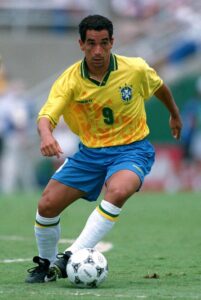
In the first article in this series about diminutives in Brazilian Portuguese, I argued that diminutives in Brazil can be used to look down on people and things. As Brazil’s bitter defeat in the 2026 FIFA World Cup recedes into the distance, an aggrieved fan could draw inspiration from the article to label the Brazilian national team a “timinho de várzea” or a “timeco de quinta categoria”(*). But enough ranting about soccer!
As a quick refresher: “(z)inho/a” are our go-to diminutive suffixes in Portuguese, and “eco/a” can do the trick as well. There are plenty of other suffixes, which I hope to examine in minute detail in due course.
Still on the soccer pitch
Let’s look at a very Brazilian tendency: the use of diminutives in nicknames. Brazilian soccer teams are a great illustration of the country’s love for nicknames that go small: chances are that any given team in Brazil will feature at least one player with an –inho or -zinho name, and the national squad abounds with examples that could trip up newcomers.
Ever since the very first World Cup in 1930, there has been no shortage of players in the miniature league of Seleção Canarinho (“Little Canary Squad,” after their bright yellow jersey… with a diminutive, of course). In 1970, Jairzinho (Jair Ventura Filho) played alongside the legendary Pelé and helped Brazil lift its third World Cup. The mythical 1982 squad included Luizinho (Luiz Carlos Ferreira), Toninho Cerezo (a common nickname for Antonio being “Tony,” now you understand the rationale behind “Toninho”), Serginho Chulapa (Sérgio Bernardino), and Zico (Arthur Antunes Coimbra). Arthur was first nicknamed “Arthurzinho,” then “Arthurzico”(**), and finally “Zico.” Zico also goes by “Galinho de Quintino” (Little Rooster from Quintino) – with an -inho, of course.
The squad that added the fourth star to the iconic Canarinho jersey in 1994 included Jorginho (Jorge de Amorim Campos), Mazinho (Iomar do Nascimento), and Zinho (Crizam César de Oliveira Filho). Jorginho is quite obvious, Mazinho will probably require a closer look, and the story behind Zinho is amusing. As a kid, Crizam was nicknamed “Crizanzinho,” but his younger sister struggled to pronounce it and simply called him “Zinho” (no wonder it stuck – the original nickname was not particularly euphonious… and would certainly have soccer commentators gasping). So it was much more convenient to use the diminutive suffix as a nickname. Zinho could well be called “Mr. Diminutive” by English-speaking commentators!
A Tale of Two Ronaldinhos

Back in 1994, seventeen-year-old Ronaldo Luís Nazário just cheered from the bench as Jorginho, Mazinho, Zinho, and their teammates played the beautiful game in the first World Cup hosted by the USA. In the tournaments that followed, Ronaldo went from the bench to the pitch and, guess what, he was nicknamed “Ronaldinho” in no time. The reason was that there was a defender who also went by the name of Ronaldo. And the defender became “Ronaldão” (the augmentative!).
Confused? Please bear with me—there is more! Ronaldo de Assis Moreira came along in the late 1990s and started calling himself “Ronaldinho Gaúcho” as a tribute to his fellow player(***). Before a crowd of Ronaldinhos came along, the original Ronaldinho was re-dubbed “Ronaldo Fenômeno,” thanks to the Italian media, which started calling him “Il Fenomeno” after he began dazzling Inter Milan fans with his talent. I guess Carnival revelers who danced to the axé anthem “Cabelo raspadinho, estilo Ronaldinho” (“close-cropped hair, Ronaldinho style”) in the 1990s still call him “Ronaldinho Fenômeno.” Ronaldinho Gaúcho played the 2002 World Cup alongside Juninho Paulista, who has one of the cutest diminutives of them all. If being a “Junior” is not small enough, then you just shrink it further with “Juninho”!
Did you think I would end this section and leave gigantic Pelé out of The League of Extra-Tiny Gentlemen? But there’s no Pelezinho, you may protest. Yes, there is! Pelezinho was a comic-book character created by Mauricio de Sousa(****) in the 1970s.
From a joke to a jersey

But for the most memorable diminutive in the 2026 World Cup, we need to shift away from massive Brazil to an inconspicuously minute Portuguese-speaking archipelago in the Atlantic. There you will find not a -zinho, but a -zinha: “Vozinha,” Cape Verde’s goalkeeper.
Josimar José Évora Dias was raised by his grandparents in Mindelo, a coastal city in Cape Verde. After school, he would play street soccer with other kids in the neighborhood. The youngest and smallest of the bunch, Josimar hated losing and would head home upset whenever things did not go his way. Just to wind him up, the other kids started teasing him for running back to his grandma after a defeat. They were soon throwing around the nickname “Vozinha” (“little granny”). “Vó” is an affectionate, informal word for grandmother in Portuguese, short for “avó.”
Years later, when Josimar moved to Angola to pursue his professional career, he encountered another goalkeeper called Josimar at his new club. Fortunately, it occurred to no one to call one of them them “Josimarzinho”—just as awkward as Arthurzinho or Crizanzinho—and having “Josimar II” on the back of his jersey was not an option. Then it dawned on him that everyone knew him as Vozinha back home. So that is exactly the name that went on his jersey!
The pint-sized boy nicknamed Vozinha became world famous during Cape Verde’s giant-defying World Cup debut, and his social media following skyrocketed from 50,000 to nearly 30 million as of this writing. I simply cannot think of another case where a derogatory nickname involving the diminutive in Portuguese went on to become an endearing nickname on such a colossal scale.
I will stop here for now, as this article is getting quite grandinho! I promise I’ll be back very soon with a new chapter in this ever-growing Diminutive Saga.
(*) To make sense of these insults, click here to read the first article in the series.
(**) -ico/a is another diminutive suffix. A burrico is a small burro (donkey); a namorico (from namoro = dating relationship) is a brief romance or a casual fling; and a veranico (from verão = summer) is an unseasonably warm spell.
(***) He added “Gaúcho” simply because he is from Rio Grande do Sul, Brazil’s southernmost state, which shares much of the gaucho culture with neighboring Argentina and Uruguay.
(****) The same cartoonist who gave us Cebolinha in Monica’s Gang and also Turma do Penadinho. Click here to read about these characters in the second installment of this series.
ABOUT THE AUTHOR

Marsel de Souza
Marsel de Souza is a full-time conference interpreter and translator based in Brasilia, Brazil. He holds a BA in Translation from the University of Brasilia and a certificate in advanced French studies from Alliance Française. Marsel regularly writes about translation, interpretation, multilingualism, and AI in T&I, including previous contributions to the PLD blog. Marsel is a certified member of the ATA (English into Portuguese) and a member of Abrates, AIIC, and APIC. He currently serves as the President of APIC.
Leave a Reply