
Meet Francisco Andrade Amiel
For this edition of the PLD Member Spotlight, we meet Francisco, a Portuguese translator whose path into the language profession began in an unexpected place: basketball.
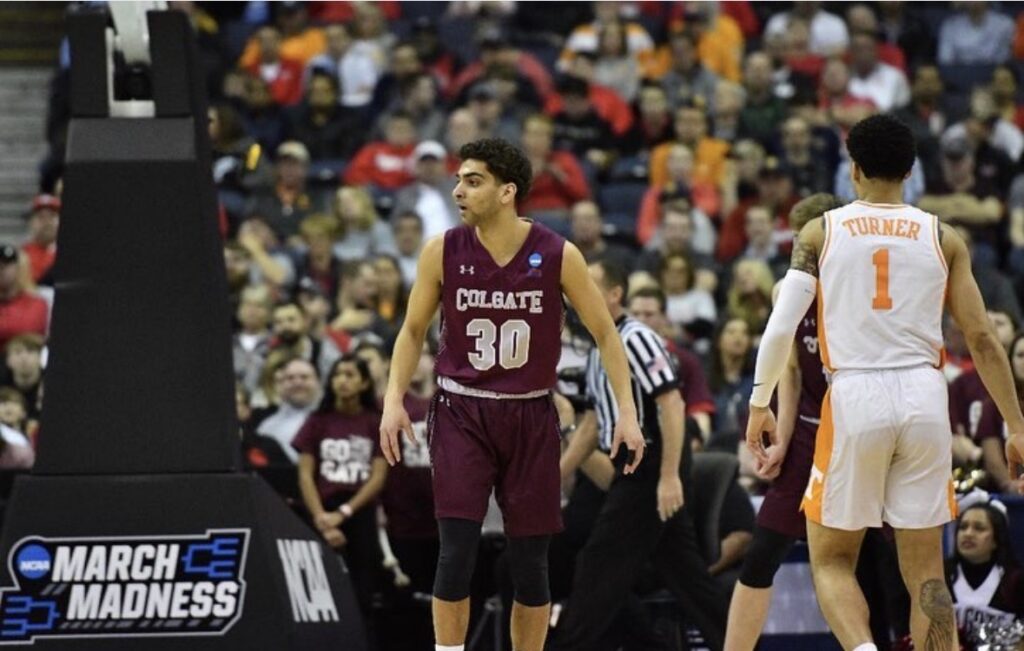
A professional basketball player who has represented Portugal and currently plays in Spain, Francisco first experienced the importance of translation from the other side of the process. His basketball career took him from Portugal to Colgate University in the United States, where he spent four years as a student-athlete. Years later, that experience came full circle when he began helping other student-athletes with the academic documentation and translations required to pursue opportunities abroad.
Now a member of ATA and the Portuguese Language Division, Francisco is developing a translation practice focused primarily on certified Portuguese-English translations in education while continuing his professional basketball career.
Let’s get to know him!
1. Where are you based, and what markets, regions, or communities do you primarily serve?
I’m from Portugal. I primarily serve the Portuguese market with Portuguese-English translations, and I’m also fluent in Spanish.
2. Tell us about your professional journey before you entered the world of translation and interpreting. What were you doing before, and how did you find your way into the language profession?
Basketball has been an important part of my life for many years. I started playing in Almada, on the south bank of Lisbon, where I completed my basketball development. During that time, I also began playing for Portugal’s youth national teams.
It was through the European Championships that I was recruited to play and study in the United States on a scholarship. I received several offers, but because I had always done very well academically, I wanted to capitalize on that background and attend a university that would be both attractive athletically and challenging academically. Colgate University offered exactly that combination.
I spent four years there as a student-athlete. After graduating, I began my professional basketball career, which continues to this day. I have played for several clubs in Portugal, represented the senior national team, and currently play in Spain.
Professional basketball requires a very structured lifestyle, but that structure also gives me some free time. It was through that time, my curiosity about translation, and the opportunity to help other student-athletes pursue opportunities in the United States that this new professional path began to develop. I’ve really enjoyed exploring this side of my professional life alongside sports.
3. You mentioned that your journey into the profession began somewhat unexpectedly and grew out of a collaboration that worked particularly well. How did that happen?
After completing my university studies and having my degrees recognized in Portugal, I began exploring options related to my fields of study on a part-time basis, since my professional life remained tied to sports.
That’s when I came across APTRAD (Associação de Profissionais de Tradução e de Interpretação) in Portugal, where I became an associate member and participated in mentoring programs to deepen my specific knowledge of translation, particularly certified translations.
I’ve taken on projects in various fields, but much of what I do today grew out of relationships with athletes who go abroad, just as I had done a few years earlier, and from handling the documentation and translations needed for their academic records at educational institutions.
It was a full-circle moment, one that I’ve really enjoyed exploring and developing.
4. What does your professional work look like today?
Right now, as a freelancer, I’ve been working mostly on certified Portuguese-English translations in the field of education.
5. What has surprised you most since you began working in translation and interpreting?
Once I began, I was reminded of the time when I, too, had to turn to someone to handle my paperwork so I could go to college, and how strongly the college emphasized that the documents had to be properly translated in order to be accepted.
I remember well how nervous I was and how important my family was during that time, especially in choosing someone with the necessary skills so as not to jeopardize my chances of admission.
It’s one of the main reasons why I love being able to give back with my knowledge at this stage of my life, because I know how important a well-prepared and well-translated document is and what a difference it can make in the admissions process at an educational institution.
6. What skills, knowledge, or experiences from your previous professional life have proved useful in your work as a language professional?
I would say that my skills and the fact that I have lived and experienced life in both the U.S. and Spain for nearly 10 years combined, being immersed in the languages on a daily basis in both work and leisure contexts, have given me valuable insight into the linguistic nuances of each language and how to adapt the tone, rhythm, and fluency required for various projects in this field.
7. As someone building a new professional path, what have been some of the biggest challenges so far? What has been particularly rewarding?
The truth is that, personally, I can’t say I’ve faced any huge challenges so far, beyond those that the world’s labor force as a whole has faced due to technological advances and the need to adapt to new realities.
One important aspect that I do find challenging is understanding and communicating the value of our work. In my experience so far, it isn’t always easy for clients or those outside the profession to fully appreciate that value.
8. Looking ahead, how would you like your career to develop?
Right now, I’m considering pursuing the ATA Certification Exam. I think it will be my next big challenge in this field.
But the truth is, what I’m most passionate about is continuing to develop my understanding of languages, words, and the lexicon as a whole. In an increasingly automated world where we see attempts to cut back on everything, including vocabulary, I believe it’s extremely important that we continue to explore languages and words, interconnect them, and understand their historical and future value for the sustainable development of societies. That’s what I intend to continue doing and exploring.
9. When did you first become involved with ATA and the Portuguese Language Division? What motivated you to join?
I joined ATA and the PLD this month, so I’m still in the early stages of my involvement, but I’m very excited about the opportunity to continue learning, growing, and discovering a whole world of possibilities in this field.
10. Even though you are still relatively new to the profession, has there been an experience that made you realize this is something you want to continue pursuing?
I’d say I’ve found a niche that I’ve loved exploring so far. But the truth is, I’m passionate about vocabulary and linguistic interrelationships.
I find it fascinating how, from a common language like Latin so many centuries ago, so many languages with such great and distinct complexities emerged, yet remain so similar at the same time. I remember arriving in Romania one day as a teenager, turning on the TV, and hearing a language in which, surprisingly, I could understand a few words.
I’ve also seen how, from my childhood through my teenage years and beyond, a country’s own vocabulary changes, and how social phenomena can completely transform and shape the vocabulary of different generations. It’s an area I’m interested in exploring further.
11. How do you enjoy spending your time outside work?
I really enjoy discovering new places, and I’ve been fortunate enough to live in and travel through various countries, which has given me incredible experiences.
At the same time, I’m very aware of how vocabulary can either enhance or limit those same experiences. Having lived for several years in different contexts with different languages has made me realize just how important vocabulary is as a tool for empowerment and personal growth in different countries and communities.
This has greatly shaped the way I view language, culture, and, above all, the ability to communicate and its relationship to one’s own identity.
12. If you weren’t pursuing this professional path, what do you think you would be doing instead, and why?
I’ll always have a passion for sports, and I believe that as long as I can combine the two, I’ll do my very best to do so.
13. What would you say to someone who, like you, is considering a career transition or is just beginning to find their place in translation and interpreting?
Honestly, it will most likely be challenging, but I think it’s one of the most essential tasks in a world that, despite being more global, is becoming increasingly closed off and isolated.
14. How can colleagues connect with you?
The best way to contact me is via email at linguisticsfa@gmail.com.
Thank you for the opportunity to introduce myself, and I look forward to meeting more colleagues soon!
Leave a Reply