 To make our Continuing Education Series Podcast more accessible and searchable for FLD members and the general public, we are now offering transcriptions of our episodes right here on À Propos. Many thanks to our volunteer transcriptionists, who are credited at the bottom of each transcription. If you’re interested in helping us transcribe podcast episodes, email divisionFLD [at] atanet [dot] org.
HOW TO LISTEN TO THE ORIGINAL EPISODE
SOUNDCLOUD: You can listen to or download Episode 36 and all previous episodes on Soundcloud here.
ITUNES: This episode and all previous episodes are available on iTunes here. You can subscribe or listen online. Like what you hear? Rate us and review us! It really helps get the word out.
[Transcript] ATA Continuing Education Series Podcast — Episode 36 — Bryna O’Sullivan on Genealogical Translation
Andie Ho: This is Andie Ho, host of the Continuing Education Series, a podcast produced for the members of the French Language Division of the American Translators Association, offering educational content about the craft of French to English and English to French translation and the division.
Hello, and welcome back to the FLD Podcast. I’m your host, Andie Ho, and our guest today is Bryna O’Sullivan, who is a Middletown, Connecticut-based professional genealogist, if you have ever heard such a thing, and a French to English genealogical translator. And as proprietor of Charter Oak Genealogy, she specializes in lineage society applications, which I had never heard of until this week, and I have lots of questions for her about that. So welcome, Bryna. Thank you for joining us.
Bryna O’Sullivan: Thank you. I’m looking forward to the questions.
AH: So, we’ve known each other for a long time, kind of on the internet. You’ve been around. Genealogical translator, it stands out because I’ve never heard of anyone else who does this kind of work. Can you tell us how you got into this?
BO: So, I come from a little bit of a different background. I am obviously American. My undergraduate degrees were dual in history, and my undergraduate university only offered a French literature major. So, I ended up graduating with a history degree and a French lit degree, as well as a minor in medieval studies. For me, doing this is kind of the perfect blend of all my skills. I get to play with the history topics I love, plus I still get to use my degree.
AH: And not everyone gets to do that in this day and age.
BO: No.
AH: So, you are a professional genealogist and a genealogical translator. Can you just give us an overview of all the services that you offer?
BO: So, the reality is, unless you were doing German translation, genealogical translation is a relatively small market. As a result, I diversified. I do a lot of what are called lineage society applications. Those are people that are applying to societies that decide membership based on your ancestry. So things like the General Society of Mayflower Descendants, the Daughters of the American Revolution, et cetera. That is the bulk of my work. I also do teaching. I also do research specifically on Connecticut, where I’m from, and then, of course, French to English translation.
AH: Interesting. So, tell me more about these lineage society applications. I mean, I’ve heard of Daughters of the Revolution. I haven’t heard of the Mayflower one. It never really occurred to me, but it’s obvious now that I think about it that, yeah, you have to prove your descendance, I guess. And so, you have to go through a whole approval process?
BO: So essentially what applicants are asked to do is document from themselves back to whatever ancestor the society considers to be qualifying. So, if you’re doing the Mayflower Society, that’s a Mayflower passenger. That means they have to get birth, death, and marriage records, and if those records don’t exist, they’re looking for other things that will document those connections. It’s a fun way, as a genealogist, to get into a lot of different areas and time periods because you’re following people all over the country, you’re looking at different historical periods, looking at record groups you might not see otherwise.
AH: Now, you said German has the most work. Why is that?
BO: So German genealogy is somewhat unique. Because there was a World War II era script change in German, Germans today often cannot read pre-1940s documents. Because of that script change, German genealogy in the US, very early on, built in a need for translation. They are very good about supporting language education. They’re very good about supporting translation. They are the only ethnic subniche that has that strong a background in translation and translation education. It’s definitely needed for other language pairs. It’s just much harder to get a foothold in because genealogists aren’t looking for it to the same degree.
AH: I see. So, other than the script change, what are some other major languages that need genealogical translation?
BO: Honestly, every language that could use it. Genealogical translation, right now, is slowly subdividing into two fields: forensic genealogical translation and historic genealogical translation. What’s the difference?
Forensic genealogist means that you’re working with court case. So, you’re looking at things like contemporary vital records, probate files, obituaries, et cetera. In those cases, they are often looking for certified translators. So, if you are interested in genealogy but don’t have that background in history, historic handwriting, et cetera, that is a really good opening. Working with a certified translator is often a good next step for someone that’s already been translating vital records for, say, schools. The same kind of needs, but it’s for a genealogical setting.
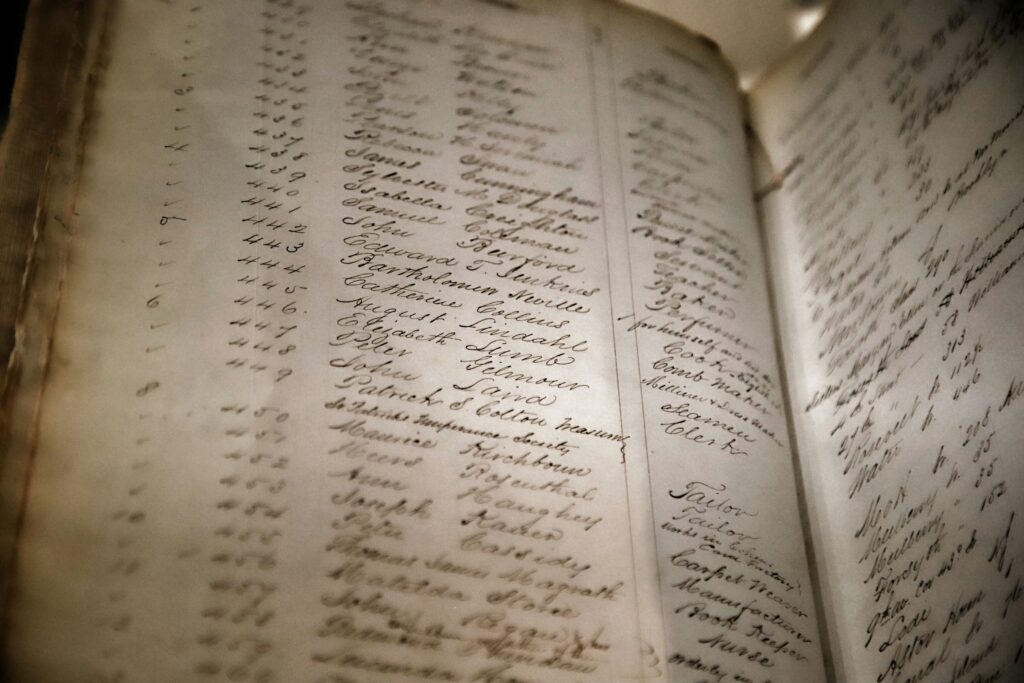
Historic genealogical translation is a lot more contextually involved. Because it’s not required by the courts, the demand is definitely smaller, and it requires a lot more background, education, and information. So, I always tell people, I’ve had stuff like estate cases from 1840. What do you need to know to deal with that? Vocabulary, handwriting, how to look up laws from 1840, et cetera.
AH: Yeah, you sometimes post on things like the FLD Facebook page asking for very specific resources. And I always think, “Oh, you know who would know? Brenda O’Sullivan. Oh, wait, she’s the one asking.” And I always want to say, you’re, as far as I’m concerned, you’re the top person in the field for this. I don’t know who you think is going to be giving you anything more, but…
BO: We’ve had a couple of colleagues who actually had French language background training in historic French, which was not part of my education, unfortunately. But, you know, 1840s fashion technology and terminology, yeah, that’s been fun.
AH: Wow. All right. So, who are the main client bases for each type of genealogical translation? You said forensic and historical.
BO: By and large, you are dealing with direct clients, so you are not dealing with firms.
In terms of forensic, you’re going to be working with a professional genealogist. The best way to get started in those cases is to get involved with the forensic genealogical groups. There’s a subsection of the Association of Professional Genealogists that is specifically set up for forensic genealogy. Learn more about what they need, and you’ll be able to better work with them going forward.
Historic translation is a little more complicated. You’re looking at dealing with ethnic groups, et cetera. I find that I get a lot of my clientele through German genealogical societies because they are working in Alsace, which went back and forth and, as a result, is bilingual. And the German genealogical societies are very used to working with translators already, so they will seek that out for French as well. But I have had, you know, Southern US, Louisiana, I’ve had Illinois, French Canada, uh, the… Saint-Domingue, getting the full run of the French Empire in a sense.
AH: Wow. So, what are the reasons that someone would want forensic or historic translations?
BO: So, they’re slightly different. Forensic really does mean you are dealing with a court. So, why is someone going to bring a genealogist into a court setting? 99% of time, it is heir-finding. Someone dies without identified descendants. There are court assets to be distributed. The court needs to identify the family, and that family has ended up spread over a couple of countries. You’re looking for multiple languages. That is the bulk of forensic work. You will sometimes see other cases, but the bulk is going to be probate.
Historic [inaudible] but a little bit more. You’re looking at things like genealogists who just want to fill in their family tree. I also work with historians. I work with academics. So, I’ve worked with art historians. I’ve worked with mainstream historians, looking at resources where they cannot necessarily translate the handwriting of the document they’re looking at. And that’s where you’re going into a little bit more depth in the historical translation.
AH: Okay, that makes sense. You said there’s a little bit more of a market for one over the other. In general, how big a market is there for all of your services as a whole?
BO: For what I’m doing, I have a fairly solid market, but the bulk of my work, as I indicated, is lineage society work. Now, that is in part because I decided I was mostly interested in historic translation. There is definitely a bigger market for forensic translation than historic translation.
AH: Gotcha. So, I’ve done one genealogical translation or, it was for one client, I did several for one client many years ago, and I was surprised by the amount of money he was willing to pay for these documents. Do you, you know, as just an amateur genealogist looking at his own family background—I personally am not that interested in my ancestors, I suppose, but some people really are—what do you find the range is for your private clients?
BO: So, there’s going to be a lot of variables. One of the realities in dealing with genealogical translation on the historic side is that genealogists love to do it themselves. And they often will resort to looking for the cheapest option available, which these days is typically large language models or AI. But there are genealogists that don’t want to do that and want a solid base and a solid translation because they know a human, especially these days, is more likely to be accurate. So, you will have some variation in market just based on what has that person done in the past, what’s their interest, et cetera.
What is worth noting in terms of genealogical translation is the billing structure is different. So, most translators are used to being paid by the word. Genealogical translators do not get paid that way. Typically, I’ve yet to run into—I think I’ve run into one person that billed that way. Most of us get paid by the hour. The reason for that is the bulk of non-forensic historical translation is handwritten. So, handwriting becomes a crucial skill in working with these documents. And that’s also a variable that’s really hard to account for. So, a document that may be very short can take a longer time because it’s really hard to read. Hence why the decision is made to bill by the hour rather than by the word.
AH: That makes sense. So, do you quote people up front and say, I think it will take me X number of hours?
BO: So, that’s been my personal decision is yes, I do quote people up front. I personally put a ceiling on it, and then if it goes beyond that, I end up just eating the cost. The reason I do that is that I find that people, if they’re willing to pay for this, are willing to pay for this, but it’s hard to pay for an open-ended budget. So, I can tell people this is going to be your maximum. I usually run below that. I end up finding I often quote twice what I actually mean, but it helps them kind of see how they’re going, especially because they don’t have that definition of having the per word.
AH: Yeah. Do you ever do any of the genealogical research yourself? Like, do you have to dive into records?
BO: In theory, no. In reality, often. One of the big problems that we face in doing this type of translation is that the person does not read the language at all. But they’ve gone into the databases or whatever archives they’re working with and pulled the documents themselves. It’s not uncommon to get half the record because they don’t know where the record ends. So, I have, more than once, gone through and pulled the next page, pulled whatever’s missing, et cetera.
AH: Are these documents generally available online?
BO: Yes. The one caveat to be aware of when you’re working with the historic documents is vitals, baptismal records—vitals, excuse me, the American term for birth, death, and marriage, civil registration in Europe—baptismal records from Quebec, for example, are accessible online. They are subject to the recording and requirements of whatever website they’re taken from. So, if you as a translator are working with a client, you may want to pay attention to that, especially if they’re planning to publish your translation to ensure that they actually have the rights for what they’ve used. More complex documents are not always available online. Notarial records are pretty commonly requested from historic translators. Those typically have to be ordered, that type of thing.
AH: So, let’s take a step back. You said, you know, the degrees that you earned really lent themselves to the job that you have now, but how did you get there? I mean, I assume you didn’t graduate, and the next day, you were a genealogical translator.
BO: No, my background was more heavily history. I actually have two master’s degrees in history. But I also did some training as a French teacher and found that I liked having the ability to keep both of those fields going. And I happened to enter the genealogical market right when it started to really professionalize.
So, initially, genealogy started out as kind of a paid hobby. People would do it when they retired. People would do it part time. Occasionally, you’d have full timers, but they were not common. About 2010 to 2015, you started to see a number of people become full-time.
What has happened is we have kind of both aspects of the genealogical profession running simultaneously right now. You have full-time genealogists; you have part-time genealogists. Part-time genealogists are more likely to be doing it as a second job, kind of a paid hobby, or be retired and doing it as a retired job. Full-timers generally are a bit younger, typically, because they started in the field and then started work at about that time period where things transitioned.
Now, for me, it was a gradual build. I started as a part-timer doing other jobs and then moved to full-time.
AH: Yeah, I know a lot of people are really into it as a hobby, like you say, especially retired people. My local library has a genealogical room and they—once, twice a year, they’ll have a lock-in, they’ll have a book sale where they have all these books that are, you know, related to genealogy for sale. It’s a whole world.
BO: Oh, okay. Yeah, if you’re not inside it, it’s hard to kind of understand the dynamics, but it definitely is its own world. It’s become profession. I mean, the example we often use is think about people that are doing sports as a hobby and the level of skill and professionalism you can have in that. Genealogy is similar.
AH: Yeah, that makes—okay, that clarifies it a lot. Yeah, you can play it with your neighbor on the weekend, or you can be on an intramural team, or I guess you could be pro, right? There’s a whole gamut. Interesting. Okay so, I’m going to ask this question selfishly, for me. So, I’m the daughter of immigrants. My parents came from China. People sometimes, you know, talk to me about ancestors and I’m like, well, I’ve been to their houses in China. Like, I know exactly where they are. But I actually don’t know that much about them. So how would one go about searching for my family history because my direct parents, my two parents, for instance, didn’t have birth certificates because they were born in a time and place where they weren’t issued.
BO: So, it’s going to depend a lot on your family’s background. So, you’re coming from a culture that often caps family books or family registers. And if you have access to that, that is a great way to get started. German families often have the same thing, depending on their locales. My own family is partially French-Canadian, which would be a fairly familiar group to many of the translators. And in that case, we’re looking more at things like Catholic baptismal records.
But no matter what you’re looking at, always start by talking to your own family, finding out what they know. Often people can give you a couple of generations back. Once you have that information, then you can start looking at whatever group of documents is going to be most useful for your family’s ethnic history, background, etc.
So, for the U.S., we always tell people get that family information, then start with the census. We have access to the census through the 1850s. If your family has been here for a while, you probably can follow them back on the census at least till 1850. Then things like birth, death, and marriage records, etc.
AH: Okay. Of course, I am one of those people who can’t read the, you know, language that my family, you know, originated from. So, I would need someone’s services like yours.
BO: Well, and that’s a reality for a lot of people doing this work, really. I honestly have to use translators for some of my own family history because my family’s part German. And I can get enough German to pick out that I have the right record, but I wouldn’t trust myself to do that. So, it’s that balancing act of getting into the history, figuring out what you can safely do yourself, and then what you need professional help for.
AH: Websites like Ancestry.com, are they any good?
BO: So, the rule of thumb with websites like that, it’s really things like looking at the individual sources rather than looking at the site as a whole. Those websites are essentially document or database aggregators. They’re pulling a bunch of different documents and databases together. Some of the stuff they’re pulling in is really valuable. For example, the French-Canadian baptismal records I just mentioned, the Drouin Collection is on Ancestry. So that is the digitization of most of Quebec’s church records after a certain point in time, or up to a certain point in time. You also have people putting up their own family trees that may or may not be fully documented and aren’t as worthwhile or reliable.
AH: What about—where do you foresee things going with things like 23andMe? I mean, that’s not really public records, but you hear about people finding relatives through it.
BO: So, the peak in the DNA sector was probably roughly 10 years ago. Those companies are kind of struggling to redefine themselves right now because the bulk of people that wanted to test already tested. So, what do you do once you’ve reached your market? Trying to figure out what the other options are, build out from there. I am not a DNA specialist, but I don’t want to speculate too much on where that’s going, but it’s definitely in flux right now.
AH: Interesting. I did hear that some of those companies were in trouble, and that makes sense why.
BO: Yeah, it was definitely a huge thing. It actually started right when I started working professionally, and it was about 10 years ago to the peak. And they’re tapping out their potential market at this point because everyone was interested, but they’ve already tested.
AH: So, off topic, while I was looking at your website and—it’s really good. If anybody needs ideas for how to build a website, honestly, go check out—is it charteroakgenealogy.com?
BO: Yep.
AH: All right.
BO: Thank you.
AH: Yeah, it’s got everything. It’s… I really felt like if I were someone looking for genealogical services, like it answers my questions up front. It takes you to the correct, you know, page and what you really need. And then you have some instructional videos on there too that people could comment on. I mean, it’s very thorough.
BO: Thank you. No, I try to put material up every time I get a question. And that’s probably actually a good rule of thumb for translators too. If you’re getting the same question 20 times, put it on your website.
AH: Oh my gosh, that’s so obvious when you say it out loud like that, but…. Okay, I’m gonna go redo my website as soon as we hang up here.
BO: At least it’ll show up in a Google search, if nothing else.
AH: Did you do it yourself or design it yourself at least?
BO: That is a commercially available template. So, it’s mostly just uploading.
AH: Love it. That’s the way to go.
BO: No web design skills on my end.
AH: Cool. Well, final question, is there anything you’d like our audience to know about anything in the whole wide world?
BO: So please, please, please, please do client education if you are interested in this, particularly if you have other language pairs. There are genealogists looking. They do not know where to look because there are so few people doing client education on historic and genealogical topics.
AH: If we hear of someone who needs a language other than French, do you have a network of colleagues?
BO: I do to a limited extent. There is definitely need. So, if that’s something that you are interested in and you have multiple language pairs, consider it. I have clients or colleagues that can do a couple of things, but especially for those of you that are Asian language focused, there’s a need and it’s not being met.
AH: All right. Word to the wise. Maybe we should publish this to, you know, the CLD, KLD, et cetera. All right. Well, thank you, Brenna, for joining us. This was very educational. We appreciate it.
BO: Thank you.
AH: This concludes our episode for today. You can subscribe to the Continuing Education Series podcast on SoundCloud or iTunes by searching for “Continuing Education Series”. You can contact the FLD at divisionfld [at] atanet.org, visit our website at www.ata-divisions.org/fld, or get in touch with us on social media. This is Andie Ho signing off. Thanks for listening and à bientôt!
ATA Podcast host Andie Ho is a certified French to English translator specializing in the food industry. She earned her M.A. in translation from Kent State University and is now based in the Houston area. She currently serves as the ATA’s French Language Division administrator. You can follow her on Twitter at @JHawkTranslator or email her at andie [at] andiehotranslations [dot] com.