The French Historical Present Tense

ata-fld-newsletter-logo

by Bruce Popp

As professional French-into-English translators, we commonly encounter the French historical present tense in meeting minutes and reports of clinical cases written by doctors. In these documents, the writers use the present tense (and thereby avoid repeated use of the passé composé and imparfait) to describe events that occurred sometime earlier. To my mind this can seem like some kind of historical reenactment. “We are standing next to the village green in Lexington. On one side Capt. Parker is steadying his company of colonial militia and on the other the vanguard of the King’s Own 10th Regiment of Foot is marching into sight.”

We deal with the French historical present tense by translating it into a past tense in English. This reflects how the corresponding documents would be written in English by a US native speaker. “The patient, a 58-year-old female, was seen in the emergency department.” “The meeting was called to order and the minutes from the previous meeting approved.”

I recently encountered a couple examples where the people preparing the translations failed to recognize and correctly handle the French historical present. Let me start by explaining the context in which I encountered these errors and then showing them to you.

After translating one book by Poincaré and signing a publishing contract, I wanted to continue my relationship with Poincaré so I started to look at what to translate next. I decided to look at an article he wrote in 1905. An enormous amount has been written about this article comparing it to one published in the same year by Albert Einstein that became the recognized foundation for the theory of special relativity. (I’ve looked at some of these comparisons; they read like a description of a tennis match: Einstein said there’s no ether and Poincaré said the ether is undetectable, but the two statements amount to the same thing? 15-15.)

There are in fact three published translations of this article by Poincaré from 1905. So far I’ve only looked at two; I’ve been too cheap to pay for a copy of the third article. I quickly realized the both translations had a mistake in their translation of the first sentence.

The first sentence in Poincaré’s article is, “Il semble au premier abord que la lumière et les phénomènes optiques et électrique qui s’y rattachent vont nous fournir un moyen de déterminer le mouvement absolu de la Terre, ou plutôt son mouvement, non par rapport aux autres astres, mais par rapport à l’éther.”

In the translation by SW, this sentence reads “It seems at first that the aberration of light and related optical and electrical phenomena will provide us with a means of determining the absolute motion of the Earth, or rather its motion with respect to the ether, as opposed to its motion with respect to other celestial bodies.”

In the translation that appears in a book by CWK, the sentence reads “It would seem at first sight that the aberration of light and the optical and electrical effects related thereto should afford a means of determining the absolute motion of the earth, or rather its motion relative to the ether instead of relative to the other celestial bodies.”

The next two sentences (still written by Poincaré in the same tense) refer to two experiments respectively by Fresnel in the 1870s and Michelson in 1887 that tried to use “un moyen de déterminer” and produced conclusive, negative results. Therefore, historically Poincaré while writing in 1905 was describing an idea that might have been held in the late 1860s, but was no contradicted by experiment.

Despite this historical clue, the people providing these two translations failed to realize that Poincaré was using the historical present tense. I translated the sentence as, “On first consideration it seemed that the aberration of light and the optical phenomenon associated with it were going to provide us a means for determining the absolute movement of the Earth or more accurately its movement, not with respect to other stars, but with respect to the ether.”

Bruce D. Popp, Ph.D. is a French into English scientific and technical translator.
Review: Translate in…/On Traduit à Québec

by Jenn Mercer

This year’s Translate in Québec/On traduit à Québec was the 8th in a traveling series of FR<>EN translation workshops focused on craft. This series, which began as a small workshop in the Catskills, has since been held in such varied locations as Cambridge (U.K.) and Chantilly (France). This is only the second one I have been able to attend and, mostly coincidentally, both have been in Québec.

Before I get in to the benefits of attending the Translate In/On Traduit À workshop itself, I must confess that visiting Québec is one of my guilty pleasures. I love going to France, and the joys and advantages of full immersion are irreplaceable, but… there’s something to be said for the convenience and vocabulary-building exercise of having bilingual versions of everything everywhere.

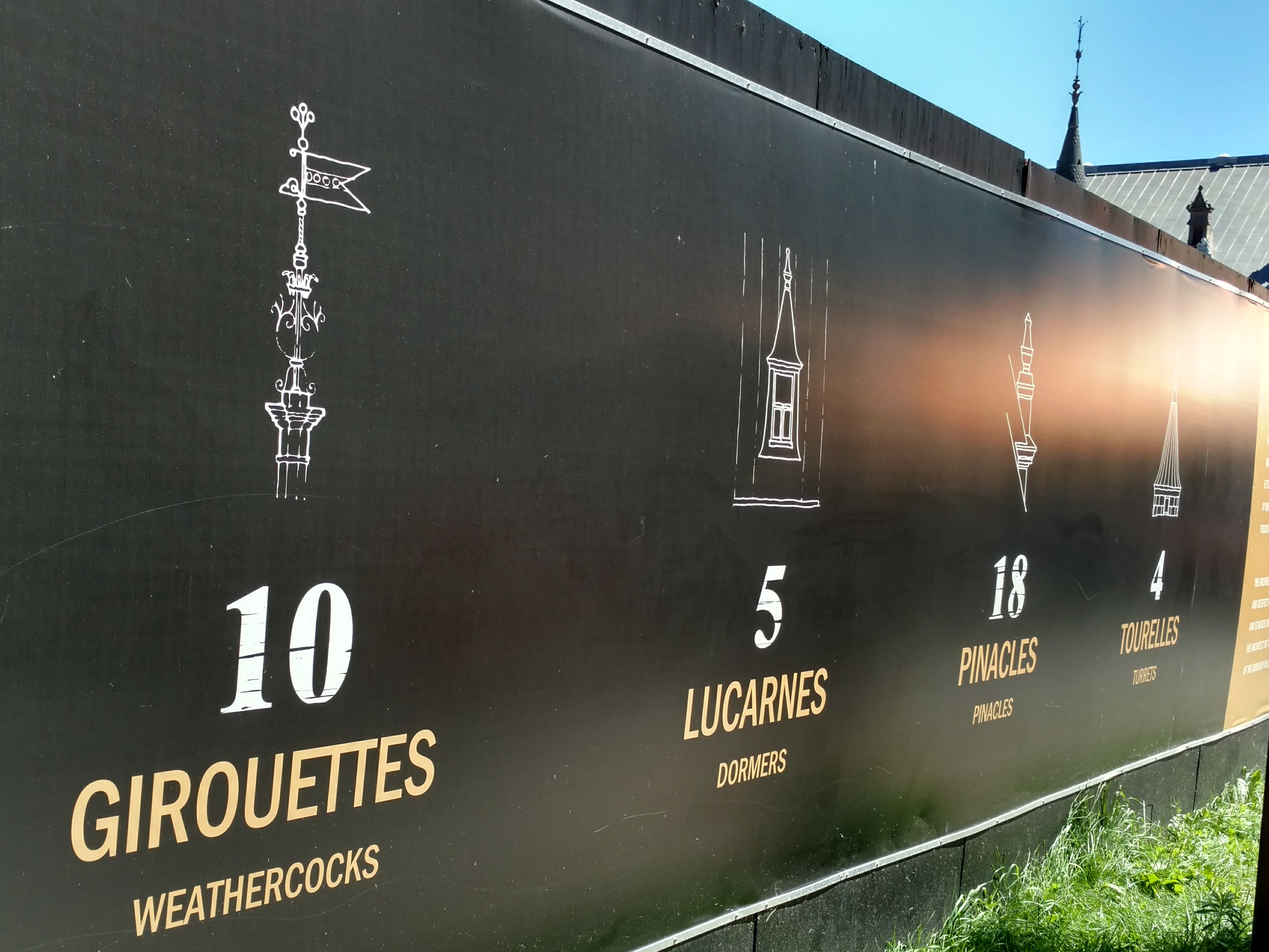
Can you believe the hotel actually apologized for the construction? My fellow translators and I were delighted by all of the detailed architectural terminology—value added! Photo credit: Jenn Mercer

However, even for those who are not language geeks, Québec is lovely and Vieux Québec was well worth the many hikes I took down and then back up to the hotel. To put the altitude changes in perspective, there is a funicular at one point and many of the staircases are named to reflect their history, but also the fact that they are a durable part of the landscape.

Nevertheless, the point of the translation workshop was to learn more about the craft of translation and it did not disappoint. Each day started with bilingual sessions featuring quick tips: Allô Docteur Termino/The Word Doctor were led by pairs of translators including Ros Schwarz, Marc Lambert, François Lavallée, Lillian Clementi, David Warriner, and Marie-Christine Gingras. These sessions were brief, but packed in so many tips, it would be impossible to summarize them here. Even the reverse sessions provided valuable tips and I quickly stopped worrying about the translation direction.

For the first two of the three days, this was then followed by a Traduel/Translation Slam with the texts provided to attendees in advance. On the first day, this was in English to French and then the second day was French to English. Again, I found myself so caught up in the myriad of choices involved in meaning and expression that I feel I got as much out of the EN>FR as I did from the FR>EN slam. If I were to offer any criticism it would be that in most real-world situations, a client would be expecting a text that stayed closer to the source. However, the looser approach taken by the duelers made for an excellent conversation starter.

After these appetizers, we got into the main course of the workshop—the single direction translation sessions. If you have attended other sessions led by Grant Hamilton or Chris Durban at ATA or another conference, you will have an idea of their style, but all of these sessions were entirely new and well worth the journey.

Grant Hamilton presented on “The Writerly Translator,” in which we got to roll up our sleeves to improve our writing skills. This was a great cross-training exercise and fit well into a theme I noticed in the workshop overall. Many of the sessions were not so much about coming up with a list of terminology, but reshaping our brains in a similar way to how higher level math allows you to “see” equations.

Chris Durban’s presentations on “Reporters in the Crosshairs” and “Helping French Companies Control The(ir) Story” used different approaches to present the responsibilities of a translator and to get a better view into the expectations of some very different target markets. The presentation on French Companies in particular was an interesting example of how the different expectations in French and English business culture call for not just translation or even transcreation, but the creation of documents that may not have even existed in the source language.

Unfortunately, I was only able to attend one of Ros Schwarz’s two sessions, but it is hard to complain about having too many options. The session I did attend, “The Sound of Music,” concentrated on writing well—regardless of how mundane the subject may be. Schwarz encouraged us to both concentrate on the basics of grammar and to free our minds and let our innate creativity take hold.

Although I cannot report specifically on Ros Schwarz’s literary translation session with François Lavallée, I did attend a session with this same pair during a previous “Translate In/On Traduit À” event and I thoroughly enjoyed the experience of having an experienced literary translator translating under the eyes of the author himself—no pressure! In fact, Lavallée was very easy to work with and provided valuable insight into his text, and the group work generated great discussion material.

This was the first time I had attended a session by David Warriner and I enjoyed the two sessions he presented and his contributions to the French>English Translation Slam. His first session was on “Premium Tips for Translating Insurance.” Warriner included both a structural overview of the translation market in Québec and the rest of Canada, as well as its repercussions on the terminology used. I found this fascinating, as I worked for years at a U.S. insurance company where everything is regulated per state. He provided a treasure trove of resources and did his very best to make insurance entertaining.

His second session, “Sailing Close to the Wind: Creativity Under Pressure,” used his experience with a very fast-paced racing event to show techniques for maintaining quality on a tight deadline. Rather than go into the minutiae of boating terminology, he emphasized the importance of knowing a field inside out before entering a premium market. His focus was on writing well when you do not have the luxury of sleeping on it or going through a thousand drafts. For a presentation based on knowing a lot about a niche industry, his tips were generally applicable and very useful to any translator.

Next, I decided to attend Lillian Clementi’s session on “Connective Tissue: Crafting More Readable Translations.” This is the one session where FR>EN translators had to make a decision on which session to attend. It is a testimony to how well-targeted these session are that this was incredibly difficult. Nonetheless, I enjoyed Clementi’s session, and translators I spoke to were happy with their choice regardless of whether they chose this or the literary translation session with Schwarz and Lavallée. Her session was on those little connecting words and the difference between how French and English use these words. It was a refreshing approach and I can see myself using the list of helpful words we developed quite often.

The last day of the workshop was structured a bit differently with a longer joint session instead of the quick tips and slam/traduel pattern. The best way to describe this might be to start with the names of the sessions in French and English:

  • FR: À contre-courant, pour des traductions encore plus idiomatiques
  • EN: Switch Hitting for More Idiomatic Solutions

Which of these titles is the original? Does it affect how you would approach their translation? In this session, Grant Hamilton and François Lavallée led us in tackling translations of difficult and highly idiomatic texts with one simple twist—our “source” text was actually a translation. After we wracked our brains, they would show us the actual source. I think we hit upon the actual phrase only once, which shows how many “correct” answers a translation dilemma can have. In all, it was the perfect grand finale to an inspiring workshop.

The theme running through all of these sessions was that of becoming a better translator, by seeing both of our languages in a new way, understanding our clients, and writing well in any language. This workshop is very different from the ATA conference. Because of this, I would hesitate to say whether one was better than the other, but I would say that every FR<>EN translator should try this at least once. You may very well get hooked.

Save

FLD Continuing Education Series – Episode 10: State of the FLD Fall 2017

Eve, Jenn, Angela - L to R
Eve, Jenn, Angela – L to R

Welcome to the tenth episode of the French Language Division’s Continuing Education Series podcast.

The main focus of this podcast is the craft of translation (English > French and French > English). It also provides a forum for the Division Administrator and Assistant Administrator to give a State of the FLD address. The purpose of this episode is to let members know what is happening with the FLD.

In today’s episode, FLD Administrator Eve Bodeux and FLD Assistant Administrator Jenn Mercer join Angela Benoit for the third State of the Division episode (episode 10 of the entire series). Get the latest on all things FLD, including a sneak preview of what your Division is planning for the upcoming the 58th American Translators Association Conference to be held in Washington, DC in October 2017.

List of links mentioned in this episode:

SOUNDCLOUD: You may access Episode 10 and other podcast episodes on SoundCloud here. On SoundCloud, you can listen to the episode in your browser or download a copy of this episode directly to your computer.

ITUNES: This episode and the entire podcast series are also available on iTunes here. On iTunes, you can subscribe or listen online.


FLD Meet-Up at the 58th ATA Conference Being Held in Washington, DC in October 2017

French Language Division Mixer/Meet-Up

When: Thursday, October 26, 2017 – from 6 to 7 pm

Washington, DC – The Sidecar Bar (at the conference hotel, the Washington Hilton)

In addition to the official FLD dinner, the French Language Division will also be holding an informal mixer/meet-up at the Sidecar bar at the conference hotel, on the Thursday evening of the conference. This informal event does not require reservations and the only cost is what you order at the bar.

Take advantage of this opportunity to meet your fellow FLD members in a relaxed environment, check in with old friends and make new connections. Feel free to drop in to this casual event for a few minutes or stay for the entire hour. This will also be a great place to organize your own dinner with FLD colleagues if you are unable to attend the official dinner.*

*This year’s official FLD dinner will be on Friday, October 27, 2017, at 7 pm and must be reserved and paid for in advance. See the FLD website for more details: https://www.ata-divisions.org/FLD/2017/08/15/fld-dinner-ata58/. Please be aware that we do expect the official dinner to sell out.

FLD Dinner in Washington, DC for ATA’s 58th Annual Conference – Sign Up Now!

FRENCH LANGUAGE DIVISION DINNER AT ATA’S 58TH ANNUAL CONFERENCE

The French Language Division’s dinner at the Washington, DC conference will be held at La Tomate Italian Bistro. We hope to see you there!

We expect this event to sell out. 

WHEN
Friday, October 27 at 7:00 p.m.

WHERE
La Tomate Italian Bistro
1701 Connecticut Avenue, N.W.
Washington, DC 20009
(202)-667-5505
https://www.latomatebistro.com/

MENU

~ SALAD – you will choose one of the following: Mozzarella over Vegetable Caponata – OR-  House Salad

~ ENTRÉE – you will choose one of the following: Fusilli – OR – Pork – OR – Salmon

~ DESSERT – Tiramisu

Note: Drinks are not included.

PAYMENT AND RESERVATIONS

Price: $56.00 per person and this includes three-course dinner, tax, and gratuity.

NOTE: All non-alcoholic and alcoholic beverages will be the diner’s responsibility and are *not* included.

Payment for the dinner must be made in advance by PayPal (https://www.paypal.com/us/home) to andie.n.ho@gmail.com and received, on or before Friday, October 9, or before the event sells out.

Please select the “send money to friends and family” option so that the FLD is not charged additional PayPal fees.

IMPORTANT NOTE: We do not provide refunds. You may sell or give your ticket to another conference attendee to attend in your place. If you do so, please notify us of the update, but the FLD does not provide refunds once a spot for the dinner has been purchased.

TRANSPORTATION

From the conference hotel, the Washington Hilton, La Tomate Italian Bistro is a 10-minute walk, one mile
along Connecticut Ave NW. For those who’d like to walk as a group, we’ll meet up in the conference hotel lobby at around 6:45 p.m.

QUESTIONS?

Contact us at divisionfld@atanet.org.

Review of Trilingual Swiss Law Dictionary

ata-fld-newsletter-logo

Review of Trilingual Swiss Law Dictionary
French-German-English
German-French-English
Thomas L. West III, JD

Review by Anne Goff

Mr. West’s new dictionary is the first trilingual dictionary focused solely on Swiss legal terms. This dictionary includes Swiss civil law, criminal law, constitutional law, debt collection, bankruptcy, and corporate law. It is divided into two parts:

  • Swiss French – Swiss German –American English translations, followed by a list of 108 French abbreviations commonly found in Swiss legal texts,
  • Swiss German – Swiss French – American English translations, followed by a list of 144 German abbreviations commonly found in Swiss legal texts.

Both lists of abbreviations include many one- and two-letter abbreviations. What frustrated translator has not learned to loathe these abbreviations after multiple fruitless Internet searches?

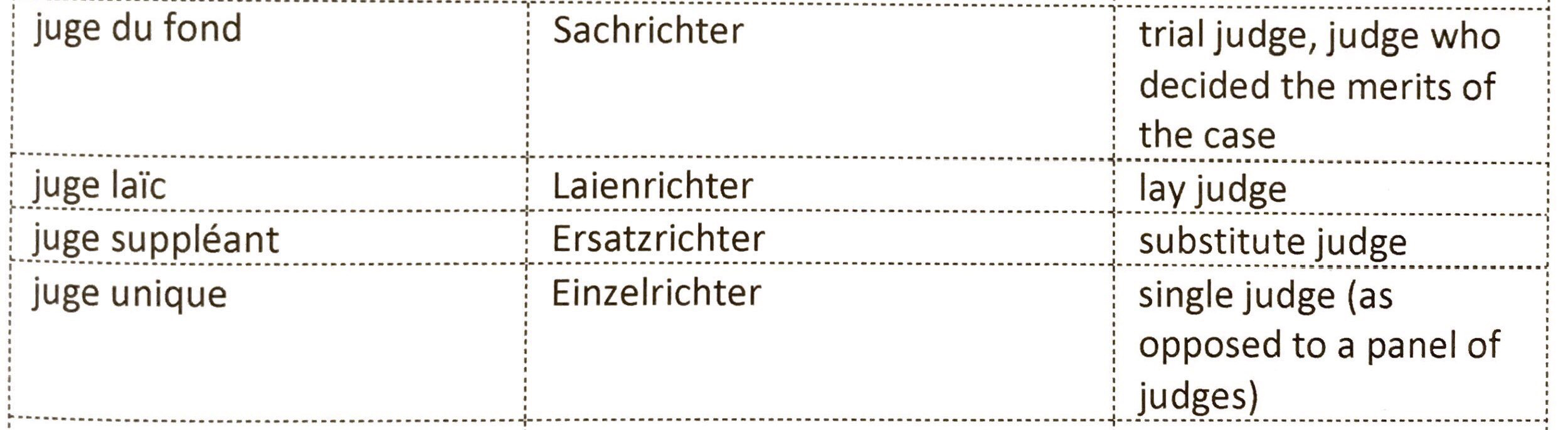
The approximately 5,750 entries in each section are laid out in columns with all three languages side by side as pictured below.

Where terms differ from their non-Swiss French or German counterparts, the corresponding term is noted after the Swiss term. For example:

  • actions liées (F : actions à cessibilité restreinte) / restricted shares, shares with restricted transferability
  • boiler (F : chauffe-eau) / hot water heater
  • case postale (F : boîte postale) / post office box
  • corps de chauffe (F : radiateur) / radiator
  • décharge (F : quitus) / “discharge” of the board of directors
  • droit dispositif (F : droit supplétif) / non-mandatory legal rule (one that can be contracted out of)
  • écolage (F : frais de scolarité) / tuition fees
  • place de travail (F : emploi) / job
  • servitude foncière (art. 730-744 CC) ( F : servitude prédiale) / easement that runs with the land
  • soustraction d’impôts (F : évasion fiscale) / tax evasion

As exemplified in the entries above, this dictionary includes quite a few non-legal terms that often appear in legal texts.

Trickier terms include a brief note of explanation. For example:

  • postulat / parliamentary motion asking the government to legislate (as opposed to a motion requiring the government to legislate, cf. motion)
  • poursuite / debt collection (legal action to enforce payment in cash or the provision of cash coverage by a debtor who fails to meet his payment obligations)
  • préfet / Chancellor of State (representative of the Cantonal Government responsible for the administration of the district)

I particularly appreciate that many terms include the precise section number of the relevant Swiss Code or Act in which they can be found. Context is key, and in legal texts, having the appropriate context is extremely important. For example:

  • prélèvement sur les biens de l’enfant (art. 320 CC)
  • présentation d’une lettre de change (art. 1011 CO)
  • divorce (art. 111 CC)
  • divorce pour rupture du lien conjugal (art. 115 CC)
  • comptabilité commerciale (art. 957 CO)
  • concentraction d’entreprises (art. 4 LCart)
  • circonstances personnelles (art. 27 CP)

The Swiss government has published unofficial English translations of major Swiss codes. Some of these translations may differ from those in this Swiss law dictionary. The unofficial Swiss government translation uses British legal language instead of American. Those translating into British English should be aware of this difference, but those translating into American English will appreciate this detail as it is often difficult to find non-EU resources for European language source texts. Some differences include:

  • court of appeals (instead of court of appeal)
  • railroad (instead of railway)
  • plaintiff (instead of claimant)
  • disability (instead of invalidity)
  • labor (instead of labour)

This focus on American English is not surprising since Mr. West earned a BA in French and English from the University of Mississippi summa cum laude and an MA in German from Vanderbilt University. After earning his JD at the University of Virginia School of Law, he was admitted to the State Bar of Georgia in 1990. Having practiced law for five years, he began his own translation firm, Intermark Language Services Corporation, specializing in legal and financial translation. This background is important in a field so full of potential pitfalls.

According to Mr. West, much of the terminology in TERMDAT appears to come from a French-to-German legal dictionary published in 1950 and compiled in the 1940s, and is thus very outdated. Mr. West’s law dictionary includes language from the new uniform civil and criminal procedure codes that took effect in 2011.

This is particularly significant since prior to 2011, there was no uniform legal code for Switzerland as a whole, and terminology varied greatly between cantons. It is important to note that the old terminology is not included in this dictionary. In the wake of the 2011 linguistic uniformization, Mr. West has published a translation dictionary that applies to contemporary legal language across all of Switzerland.

I believe this Swiss law dictionary will be a beneficial resource for translators working with French-language legal texts.

PURCHASING INFORMATION:

Trilingual Swiss Law Dictionary
French-German-English
German-French-English

By Thomas L. West III, JD
Intermark Language Publications

ISBN: 9781929570034
© 2017

Available at: https://www.createspace.com/7087174

$59.90

510 pages

≈5,725 entries

6 x 1.2 x 9 inches

1.9 lbs.

Reviewed by Anne Goff

Anne Goff is a French-to-English translator and professor at California State University Sacramento.

Some Thoughts on Translating Poincaré

ata-fld-newsletter-logo

At the American Translators Association (ATA) conference in San Francisco in November 2016, I talked about Translating Poincaré. Instead of providing a summary for this blog of what turned out to be a very interesting talk, I’d like to discuss some related points that didn’t make it into that talk. My presentation discussed the book I translated, Sur le problème des trois corps et les équations de la dynamique, by Henri Poincaré. The book transformed the study of orbits in the solar system. Before the book was published, the motion of planets in the solar system, governed by Newton’s deterministic laws of motion and gravitation, was thought to run like clockwork, and most efforts were focused on the computation of positions of the planets and effective methods for doing those computations. In his book, Poincaré instead studied the differential equations (the actual mathematical form of the laws of motion) and their properties as a specific example of a dynamical system and was able to build the mathematical proofs and tools of dynamical systems theory. After the book’s publication, it was known that the stability of the solar system is not assured since it could be subject to chaotic behavior like other dynamical systems. Since the conference, I have signed a publishing contract with the publishing company Springer, and they are preparing my translation for publication.

Why this book?

I first heard of this book either around 1978 while I was an undergraduate at Cornell University or around 1982 while I was a graduate student in the astronomy department at Harvard University. I no longer remember the particular time or context although there are a few conceivable possibilities.

What is clear, many years later, is that I was in an environment that recognized, respected and understood (on some level) the importance of this book. And, it did so despite two obstacles. The first was of course its age; it was published in 1890. The other obstacle, from the perspective of a US academic environment, was the language; it was written in formal French with a specialized vocabulary demanded by the subject matter. In 1982, I spoke French that was fully adequate for many purposes. Yet it then seemed to me unlikely that I would be able to read and understand Poincaré’s work, so I made no effort to try. Together, this means that the book was a classic, but inaccessible to a large readership even though its existence was well known.

On the way from 1985 (when I was awarded a PhD) to 2014, my life and career experienced some strange twists and turns and sharp bumps and jolts. By then I’d become an established, independent translator from French into English working mostly with complex technical subjects.

One of the distressing realities of freelance work is the unpredictable switch between frenetic feeding frenzy and frustrating famine. In the spring of 2014, during one such famine, I started to look for stimulating intellectual activity to fill the time until the next feeding frenzy hit. I immediately focused my search on potential projects that could make a connection back to what I had once been: an astronomer and mathematical-physicist

In fairly short order I had a few ideas for projects involving dynamics and the stability of rotating astrophysical fluids. I talked to some people. I tried to assess the effort and resources that might be needed. While this route seemed plausible, it didn’t grab hold of my interest and hang on.

At the same time, my interest in Henri Poincaré’s work resurfaced. I found Poincaré to be a compelling author. I was very interested in carefully understanding what Poincaré had written. What better way to do that than to translate his book? I quickly found that it was easy to find scanned images of his works online. (The website hosted by the Université de Lorraine for the Henri Poincaré Papers, and its bibliography in particular, is very useful.) In addition to this book, I also looked at Les méthodes nouvelles de la mécanique céleste and his three books popularizing science (La Science et l’hypothèse, La Valeur de la science and Science et méthode).

These last four books all had existing translations of unknown quality. It was also clear that typesetting the equations in Sur le problème and Les méthodes nouvelles would require a significant effort. On the other hand, I recognized that I would likely find that effort satisfying. My presentation at the ATA conference discussed what was involved in typesetting the equations for one page.

I prepared a sample translation of a chapter from La Science et l’hypothèse, and after discussions with Maria Ascher and Michael Fischer—then at Harvard University Press—I decided to dive in and start translating Sur le problème, motivated by my interest in the author and subject.

As paying translation work flowed in, I translated patents and documents for clinical trials, and as that work ebbed, I went back to translating mathematical physics. In that way, I got two things that really interested me: stimulating intellectual activity and close, detailed study of a book and author that had long interested me.

Errors and Typos in the Source

The published version of Poincaré’s book that reached the public had a limited amount of lint, or distracting errors of a typographic nature not affecting the fabric of the work. I found twenty-six. For example, in one place the equation numbers advance from 3 to 5, and equation 4 does not appear anywhere else in that section. Nothing can be done about an error like that during translation, and so the error is replicated. On the other hand, on the next page the first subscript, ,was incorrect, but I could easily correct it to . With other similar errors, I corrected them unobtrusively.

My Approach to the Translation

In preparing this translation, I tried to keep several objectives in sight. The first was accessibility. At one level, this objective is valid for any translation. The purpose of translation is to take a document which was written (and therefore accessible) in one language and fit for one particular purpose and render it in another language (making it accessible in that language too), where it is fit for the same purpose or some analog thereof. In this instance, I understood that purpose to be a scholarly presentation of Poincaré’s ideas and approach to studying and understanding dynamical systems, and particularly the general three-body problem. This implicitly includes the ideas of time and audience: one hundred twenty-five years later, the expected audience for my translation is English-speaking people knowledgeable in dynamical systems wishing to understand how a foundational classic of the field established and set its direction.

Looking deeper, there was also the issue of voice. In the translation I tried to avoid speaking in my own voice, meaning retelling in my words what Poincaré wrote, and tried to follow closely what and how Poincaré wrote, letting his voice come through while respecting the standards of grammar, syntax and phrasing expected in contemporary, professional US English.

Essential to both of these is the matter of accuracy. In preparing my translation, I worked through and sought to understand what Poincaré was writing about so that I would be able to accurately present it in my translation. I then checked and rechecked this translation to eliminate any misunderstanding, inconsistency or infelicity that might have gotten through anyway. I am human, so I can be certain that I was not fully successful despite my best effort.

My opinion that this is a classic of the literature of mathematical physics that deserves to be understood, and that Poincaré merits the recognition and credit that follows from that understanding, was fundamental to my effort and motivation.

Bruce D. Popp

Bruce D. Popp, Ph.D. is a French into English scientific and technical translator.
 

Join us for ATA’s 58th Annual Conference!

The American Translators Association will be hosting its 58th annual conference for translators, interpreters, and agencies from October 25 through October 28, 2017 in Washington, DC. Join colleagues in several days of learning, networking, and other business opportunities. Registration is now open!

To learn more about the conference, click here.

Accommodation information is available here.

You can also follow the fun on Facebook or Twitter using the conference’s special hashtag, #ata58.

FLD Continuing Education Series – Episode 9: Pet peeves & bêtes noires des traducteurs FR<>EN

Welcome to episode 9 of the French Language Division’s Continuing Education Series podcast. The main focus of this podcast is the craft of translation (English > French and French > English). In this episode, Miranda Joubioux joins Angela Benoit to talk about a Facebook group called called Pet peeves & bêtes noires des traducteurs FR<>EN, which Miranda co-administers. Find out what recurring challenges French/English translators struggle with and listen to some of the elegant and creative solutions suggested by members of the group. Before you leave, make sure to join the group and contribute to these engaging conversations.

About Miranda Joubioux

Miranda Joubioux was born in the region of Dublin, Ireland and has been living in Brittany, France for 27 years. She translates from French into British English, under the name of ART4U, a company she set up in 2004. She specializes in the nautical industry, architecture and construction, as well as the Food Industry. She is an active member of the Société Française des Traducteurs. In 2014, she contributed to their review Traduire, with an article on La crème de la crème. She is a member of a number of Facebook groups for translators and runs Pet peeves & bêtes noires des traducteurs FR<>EN, a group focusing on translation skills. Whenever she’s not involved in wordplay, you can find her walking her dog, kayaking, gardening or listening to music. Join her on TwitterLinkedIn, and Facebook and learn more!

A Special Announcement

On behalf of the French Language Division, host Angela Benoit would like to thank Andrew Mucci of Sennheiser for a very generous gift. Andrew found out about our podcast and gave us a mini digital clip-on microphone called the ClipMic digital. Designed for podcasters, it produces fantastic sound, even when we record over phone lines with our guests who live overseas. Thank you, Andrew! 

Listen to The Podcast

SOUNDCLOUD: You may listen to all of the FLD’s podcast episodes online or download them from SoundCloud.

ITUNES: You may listen to all of the episodes online or subscribe to the podcast on iTunes. Have an idea for a new podcast episode  that addresses the craft of English > French or French > English translation? Contact us!

I Tried It: Hiring a Translation Intern

ata-fld-newsletter-logo

One of the best business decisions I’ve made in recent years was to hire an intern. I had learned about it while take a massive open online course (MOOC) on employment law through Northwestern University. If you don’t have a budget to pay an assistant yet, or want to test the waters before you hire part-time help, recruiting an intern is a solid move.

Because of the nature of labor laws, an intern generally can’t produce work product for you. (If you’re not compensating them, you can’t earn profits off their labor.) Interns must have documented knowledge gains from their experience, and they have to learn about the meat of what you do – coffee jockeying and photocopying shouldn’t be their main responsibilities. Likely, working with an intern will have a negative ROI – it will take some time away from your regular work, and for anything they produce you will have to take extra time to correct it. But it’s not as useless an effort as the language of the law makes it sound.

I found my intern like most opportunities I’ve had in business, through happenstance. M. graduated from the same departments at my alma mater as I did, and her advisor had suggested she contact me in late 2014 with questions she had about becoming a translator.  (The French Department was putting together a program on alumni who actively use their language degree in their career, so my name was already being thrown around in those discussions.) I had put out a call for a remote-working intern through the University of Virginia alumni career board with only OK results. M., on the other hand, was a perfect candidate and her interests aligned with mine; it was a natural connection.

We set up a 20-minute telephone call to discuss logistics, our mutual expectations, and some of her other questions about the field. A week later, M. submitted her resume and an example of her translation work (executed as part of coursework, rather than for a client). Based on her availability and my own, we decided to work together for 10 weeks by email, with weekly telephone calls to discuss assignments in detail. She signed a standard non-disclosure agreement before we started; you may also consider using a non-compete agreement or limiting access to your active client database.

In order to meet the legal requirements of having an intern and still get something helpful out of it for my business, I created a curriculum for M. that gave her an introduction to the business side of things and also had “real-life” translation assignments based on my past client work. M. had what we called “permanent tasks,” to be completed every week, and also “variable tasks,” which alternated between language and business lessons. All of it was designed to be doable in 8 hours or less of her time per week – since I didn’t have the budget to pay an assistant, I wanted to be sure she could help me around an income-generating job. Everything was flexible except the weekly phone calls, which I structured using preset agendas.

The permanent tasks related to market research and advertising. She was responsible for sending me links to 5 articles of interest to the translation community every week; this helped her form an important habit for herself and learn more about the industry, and I used the links I liked to post to my social media. She was also responsible for submitting the names of at least 3 new prospective clients or events in my area that might be useful for meeting potential clients; this gave her insight into how prospecting works, and I learned of events I may not have found on my own. She was also responsible for coming up with “fun stuff,” mainly related to marketing. This is a skill that is difficult to teach – applying your creativity to business, and learning to create your own tasks. If you’ve only ever worked as not-a-boss, it can be difficult to learn to make up a to-do list for yourself. Through this permanent task, M. came up with some fun quote pictures for me, which were becoming popular on social media at the time.

The variable tasks were more like homework assignments from traditional courses. M. translated short passages from my prior client work on a range of subjects, including a diploma translation assignment that proved helpful to her in a later job. She learned to create glossaries and take the time to focus on deceptively simple phrases (“Je suis Charlie” was our first example). She learned how to cold-call people and find out how much agencies versus individuals charge for certain kinds of work. I provided her with an office form I use to track common errors (which I catch during the proofreading stage of projects) and differences in various client styles. We also discussed client management issues, such as how to set up a new project cleanly and work with a range of client personalities.

Throughout the 10 weeks, we had a constant dialogue for feedback – Were the assignments addressing her needs? Were they addressing my needs? Were we communicating our expectations well? Based on her comments after the internship ended, she gained confidence in her abilities, new skills, and a wider perspective of what translating professionally truly entails. I strengthened my ability to manage others, delegate tasks, and separate business concerns from language concerns. The experience also forced me to organize myself better and to actually implement some of the systems I had set up for marketing.

In all, it was quite a rewarding experience to be both a boss and a mentor. She still sends me links of interest from time to time, and I still answer her occasional questions as she finishes up school and enters the working world. If you are looking to do something new with business in 2017, definitely consider an internship program!

Carolyn Yohn

Carolyn Yohn translates French and Hungarian legal and academic texts into American English under the name Untangled Translations.